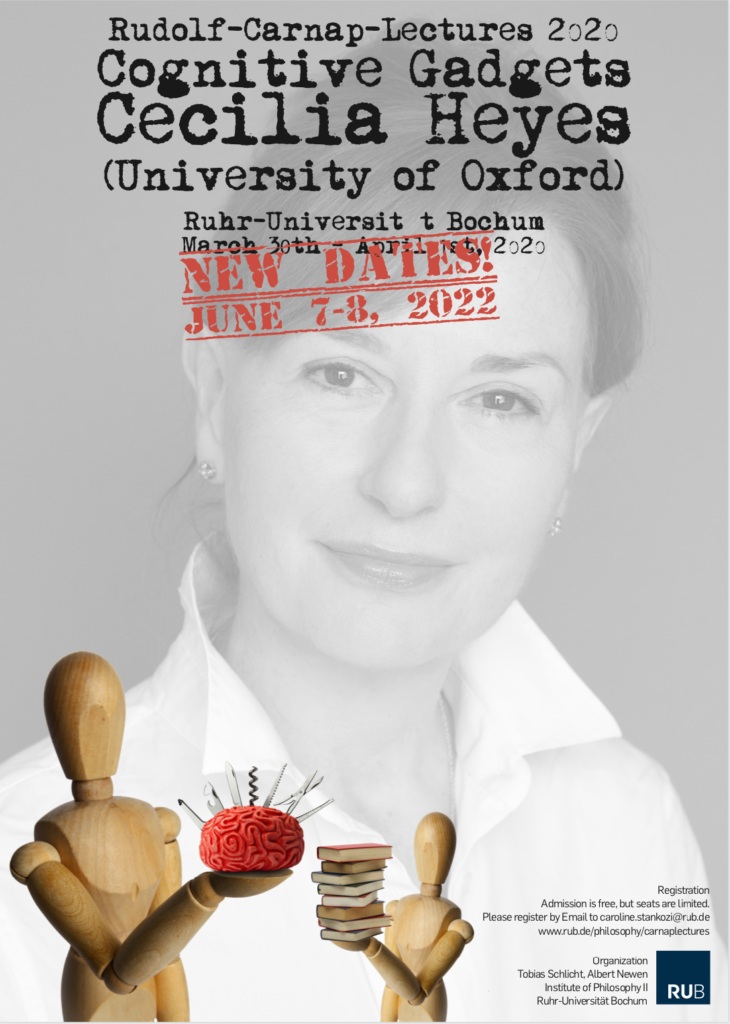
Prof. Heyes‘ work concerns the evolution of cognition. It explores the ways in which natural selection, learning, developmental and cultural processes combine to produce the mature cognitive abilities found in adult humans. She is especially interested in social cognition.
Her current projects examine whether the neurocognitive mechanisms enabling cultural in-heritance – social learning, imitation, mirror neurons, mind reading, etc. – are themselves products of cultural evolution.
Her three lectures will cover material from these areas, based on her book “Cognitive Gadgets” (Harvard University Press), but also new work ensuing from this book.
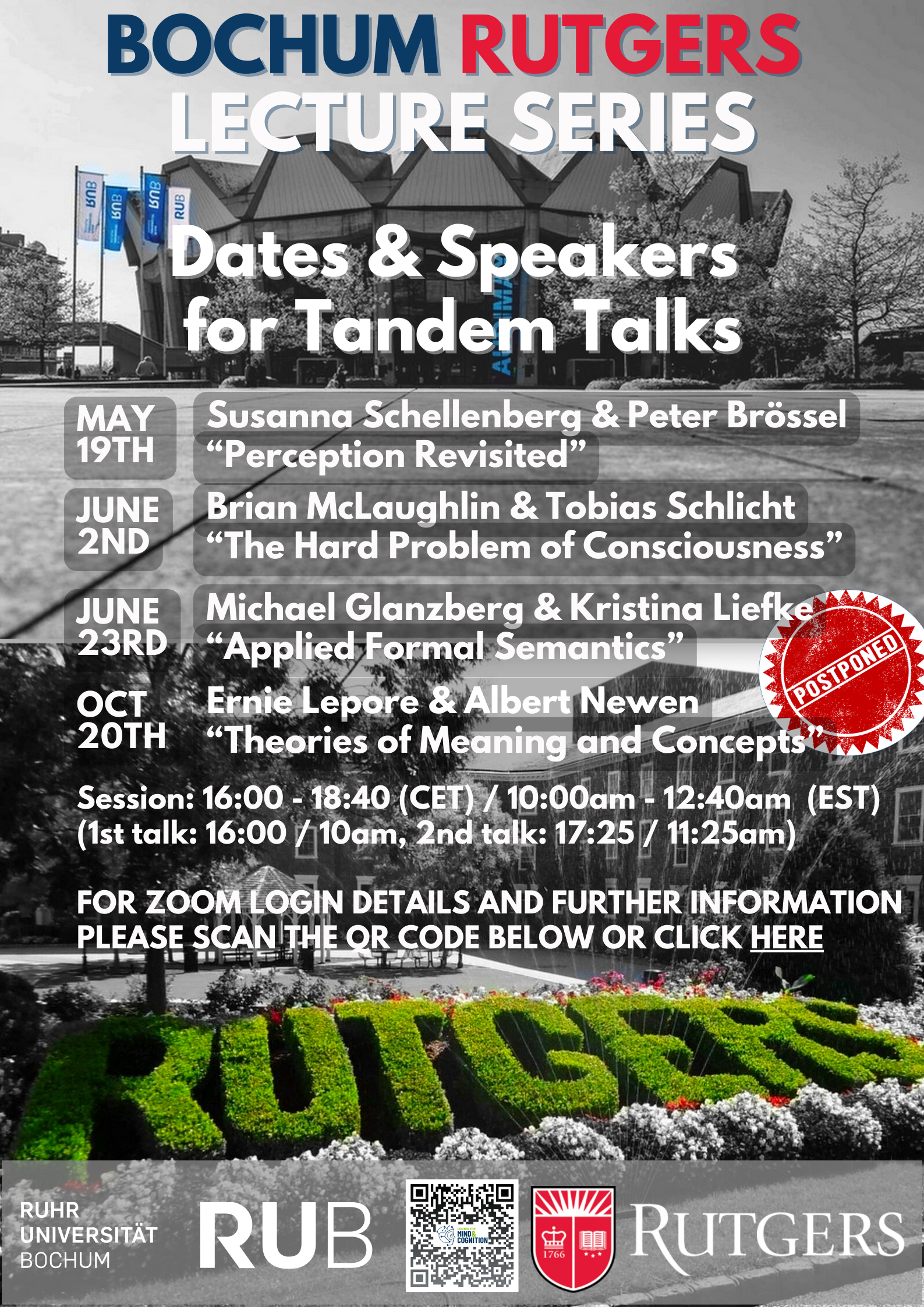
MAY 19TH 2022 “Perception Revisited” 1.) Susanne Schellenberg (Rutgers), “Perspectival Variance and Perceptual Constancy” 2.) Peter Brössel (RUB), “Perception and Updating”
JUNE 2ND 2022 “The Hard Problem of Consciousness” 1.) Brian McLaughlin (Rutgers), “Subjectivity in an Objective World” 2.) Tobias Schlicht (RUB), “The Unbearable Uselessness of Zombies”
JUNE 23RD 2022 “Applied Formal Semantics” 1.) Michael Glanzberg (Rutgers), “The Cognitive Roots of Adjectival Meaning” 2.) Kristina Liefke (RUB), “What are Experiential Attitudes?”
October 20TH 2022 (New Date) “Theories of Meaning and Concepts” 1.) Albert Newen (RUB), “The Social foundation of Meaning: Lingustic Understanding is Person Understanding” 2.) Ernie Lepore (Rutgers), “Meaning”
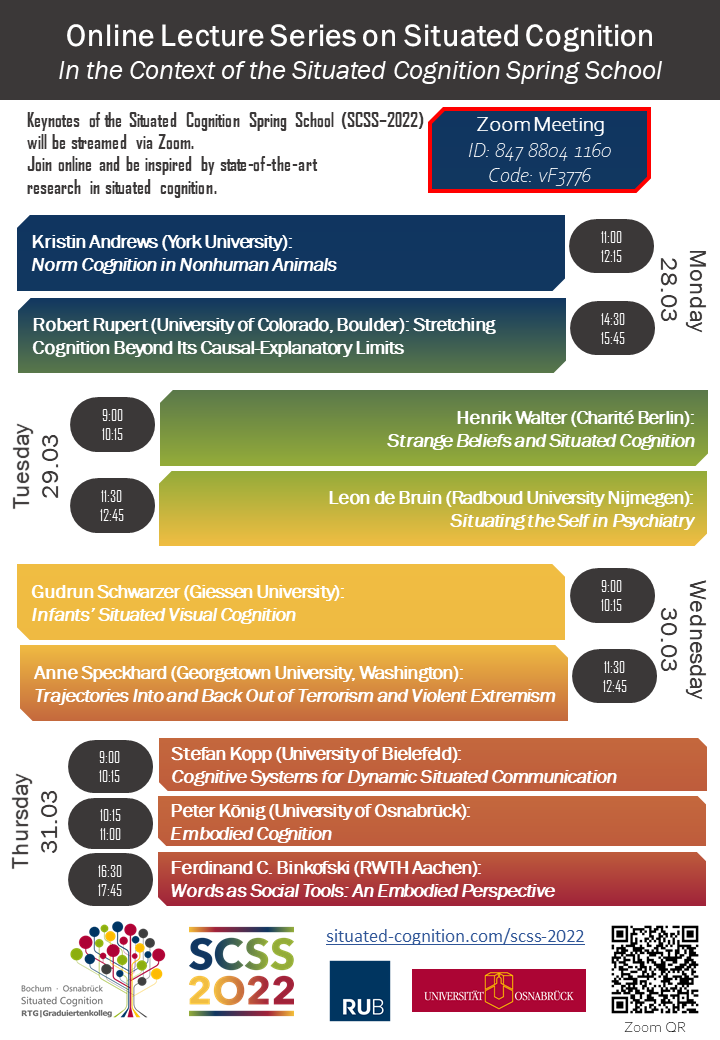
In the Context of the Situated Cognition Spring School
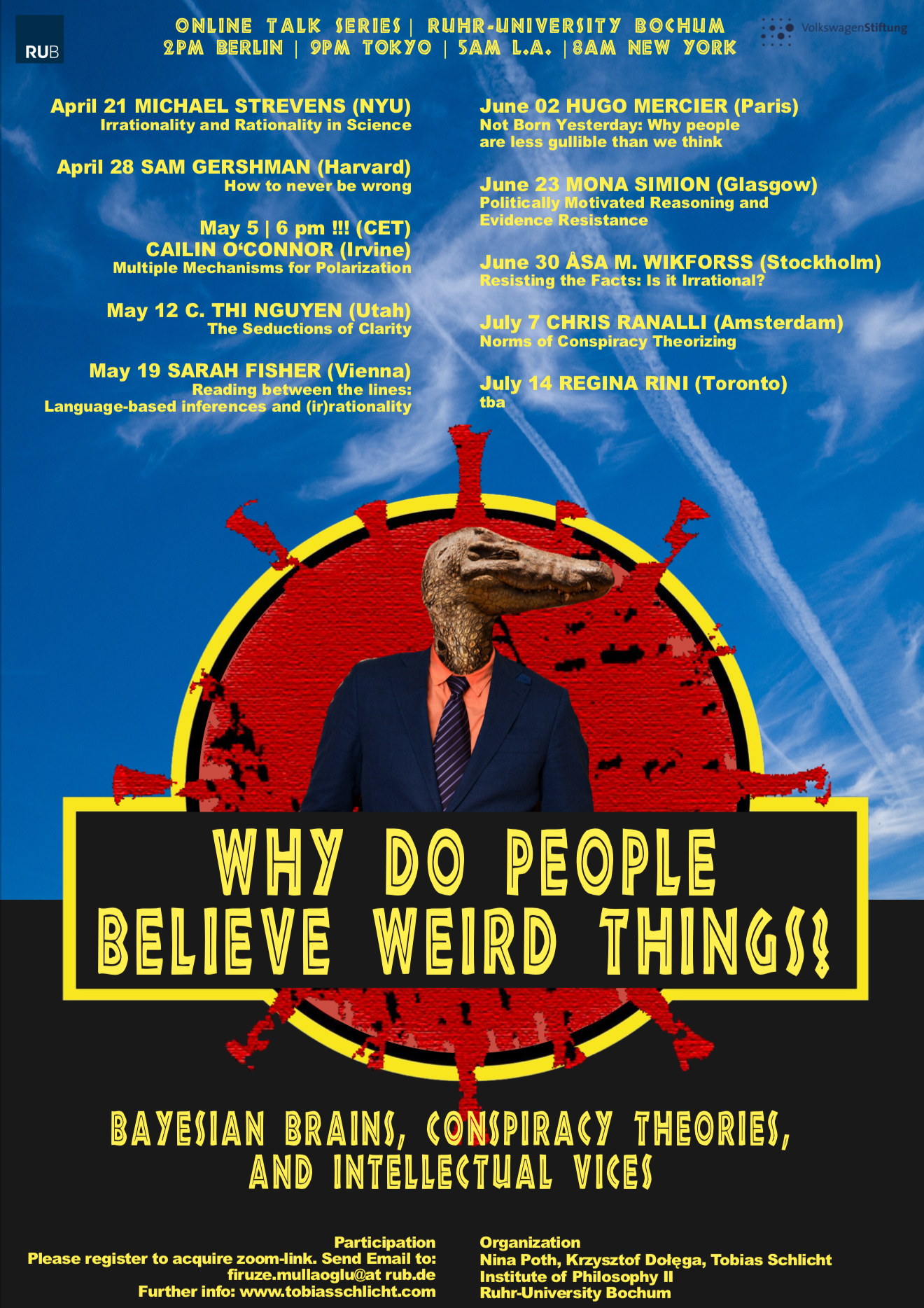
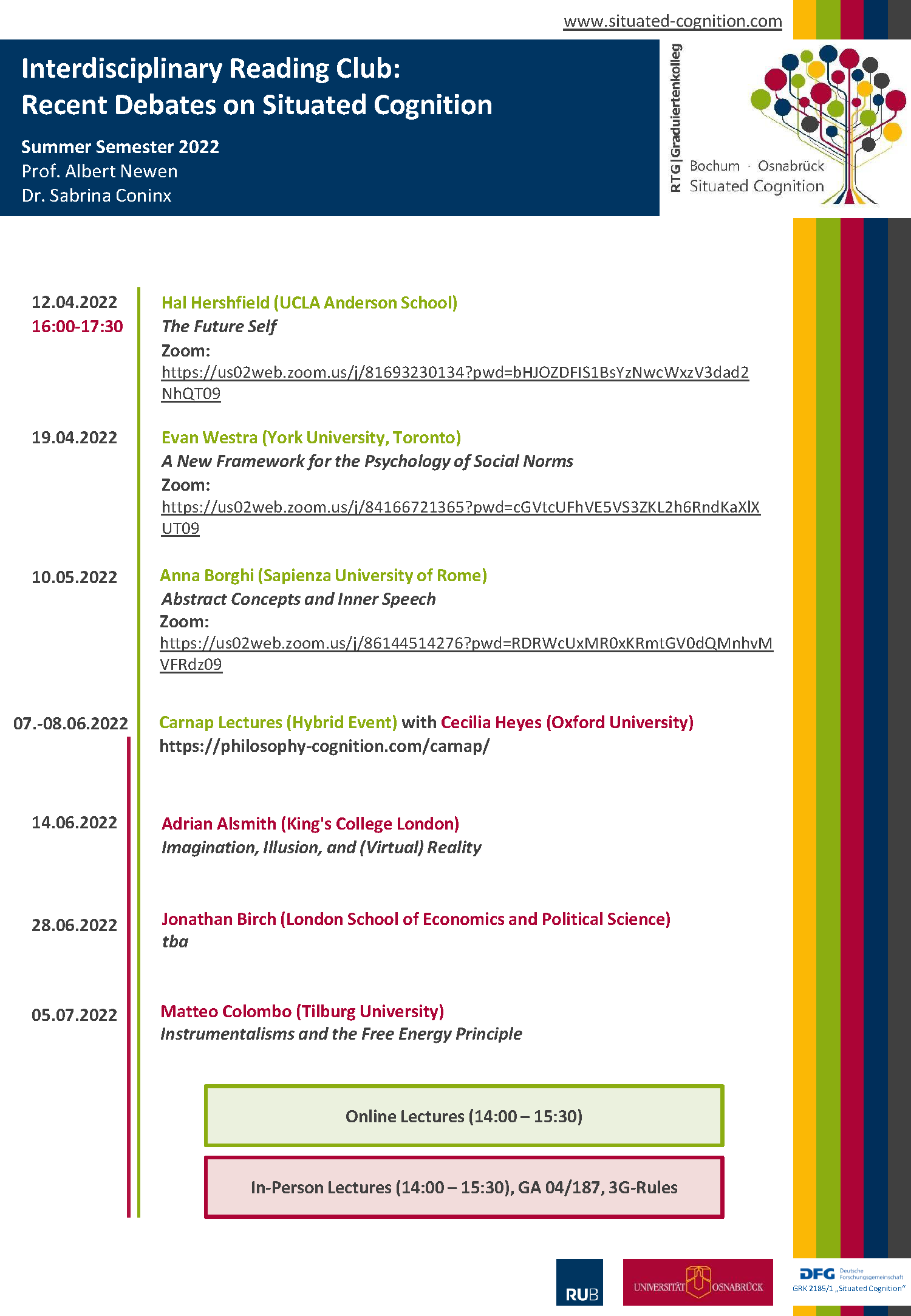
Keynotes of the Situated Cognition Spring School (SCSS–2022) will be streamed via Zoom. Join online and be inspired by state-of-the-art research in situated cognition research.
For detailed information on this year’s Online Lecture Series in the context of the Situated Cognition Spring School click here.
In order to express our solidarity with the people in Ukraine, who face the destruction of their universities by the Russian army and an attack on the values we believe in: peace, democracy and freedom, the Research Training Group (RTG; DFG-Graduiertenkolleg) “Situated Cognition” offers a few fellowships based on our DFG-funding. We focus our support on the subject of philosophy. Since the RTG is bi-local the philosophers can be based either at the Department of Philosophy II at Ruhr-University Bochum or at the Department of Cognitive Science at Osnabrück University.
We provide funding for philosophers on all career levels, from graduate students to visiting professors. The fellowship can be taken for max. 3 months. But we support an application at the Humboldt-Foundation which offers special funding for Ukrainian researchers in the present situation (These follow-up fellowships are not available for PhD-students):
What we offer in addition:
We support traveling costs to Bochum or Osnabrück.
You will be embedded in an outstanding research department in Europe at Bochum or Osnabrück.
Eligibility:
You are a philosopher from Ukraine and are affected by the war.
You are a PhD-student or a researcher in philosophy.
Please get in contact with us via: rtg-situatedcognition@rub.de and send us your CV. Only in the case you want to apply for a specific research project, you have to add a one-page outline of possible projects (see webpage mentions above). If you have questions, please visit our website or get in contact with us via mail.