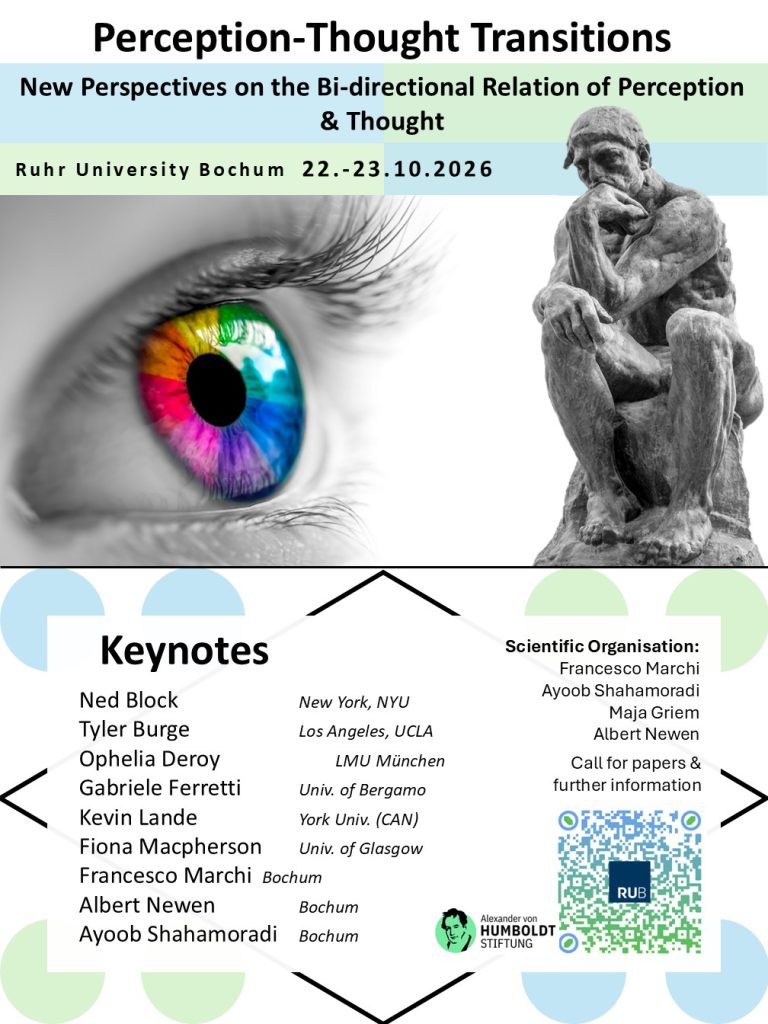


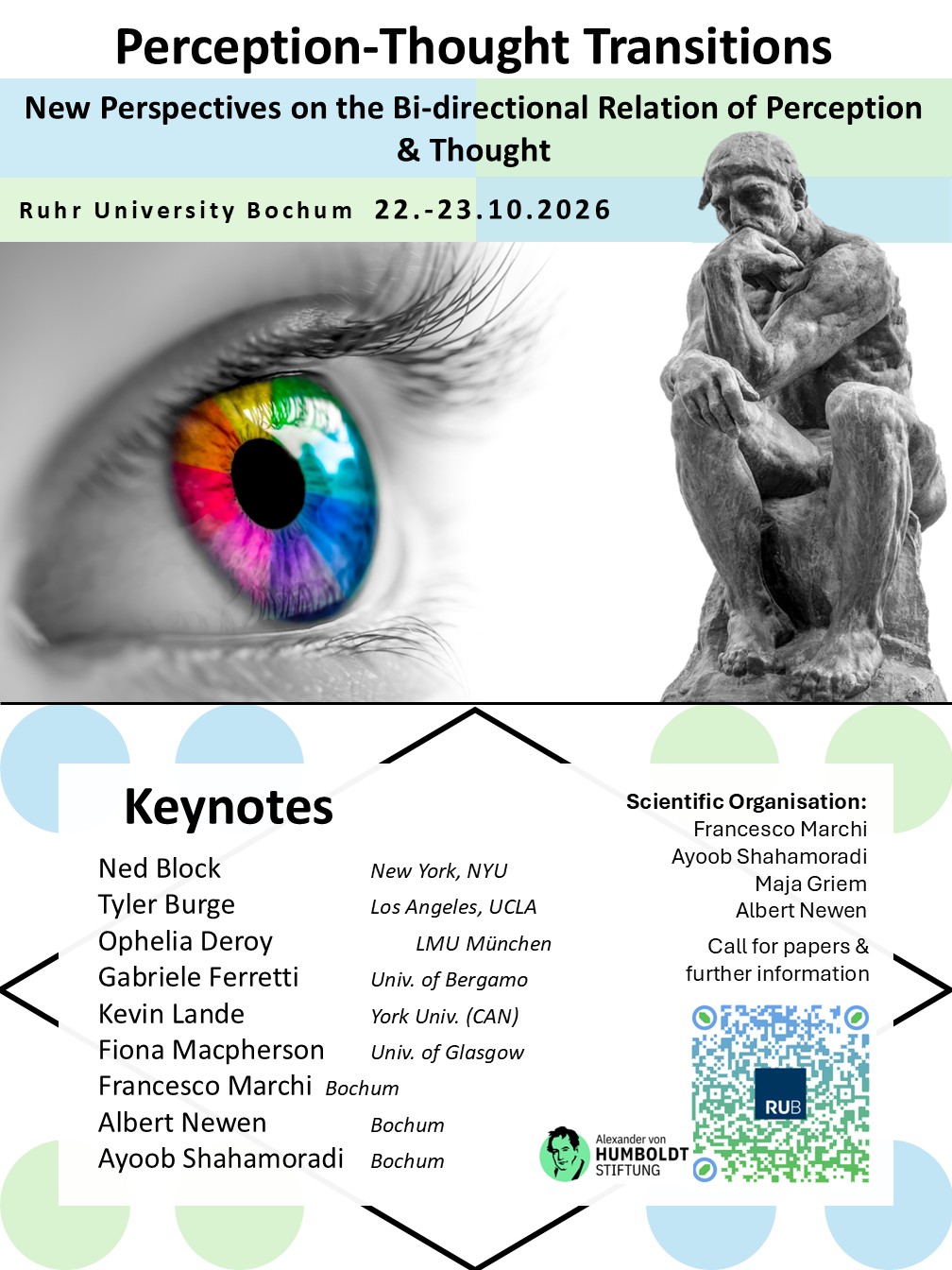
Recent News

Venue: BlueSquare, Bochum City Center (Tue) & Tagungsraum II, Mensabuilding, RUB (Wed & Thu)

Conference Homepage: https://predcommlab.github.io/symposium-2026/#about
Upcoming Events

18
Nov

<i>Philosophy</i> <br>Megan Peters (UCL) & Hojjat Azimi Asrari (UCL)<br><b>How Brains Build Higher Order Representations of Uncertainty</b>

November 18
6:00 pm - 7:30 pm
23
Nov

<i>Biopsychology</i> <br>Anika Kuckertz (Heinrich Heine Universität Düssledorf) & Kai Benning (FZ Juelich)) <br><b>TBA</b>

November 23
1:15 pm - 2:45 pm
24
Nov

<i>Philosophy</i> <br>Nathan Wildman (Tilburg)<br><b>Fictional virtual actions</b>

November 24
2:15 pm - 3:45 pm
24
Nov

<i>Cognitive Psychology</i> <br>Leander Fester (RUB) <br><b>Freezing in humans? Postural sway as a readout of conditioned fear</b>

November 24
4:15 pm - 5:45 pm
25
Nov

<i>Philosophy</i> <br>Krystyna Bielecka (University of Warsaw) & Marcin Milkowski (Polish Academy of Sciences)<br><b>Contentful Skills: Procedural Memory and the Representational Challenge to Non-Representational Cognition</b>

November 25
6:00 pm - 7:30 pm
26
Nov

<i>Philosophy</i> <br>Henry Taylor (University of Birmingham) <br><b>TBA</b>

November 26
12:15 pm - 1:45 pm

Relevant Publications

For full list of selected publications, see the publications page

Stress, path integration, and the entorhinal cortex

6812496 {18825267:B3MP3TEI} 1 apa 50 default 6832 https://philosophy-cognition.com/cmc/wp-content/plugins/zotpress/
%7B%22status%22%3A%22success%22%2C%22updateneeded%22%3Afalse%2C%22instance%22%3Afalse%2C%22meta%22%3A%7B%22request_last%22%3A0%2C%22request_next%22%3A0%2C%22used_cache%22%3Atrue%7D%2C%22data%22%3A%5B%7B%22key%22%3A%22B3MP3TEI%22%2C%22library%22%3A%7B%22id%22%3A18825267%7D%2C%22meta%22%3A%7B%22creatorSummary%22%3A%22Wolf%20et%20al.%22%2C%22parsedDate%22%3A%222026%22%2C%22numChildren%22%3A1%7D%2C%22bib%22%3A%22%26lt%3Bdiv%20class%3D%26quot%3Bcsl-bib-body%26quot%3B%20style%3D%26quot%3Bline-height%3A%202%3B%20padding-left%3A%201em%3B%20text-indent%3A-1em%3B%26quot%3B%26gt%3B%5Cn%20%20%26lt%3Bdiv%20class%3D%26quot%3Bcsl-entry%26quot%3B%26gt%3BWolf%2C%20O.%20T.%2C%20Akan%2C%20O.%2C%20%26amp%3B%20Axmacher%2C%20N.%20%282026%29.%20Stress%2C%20path%20integration%2C%20and%20the%20entorhinal%20cortex.%20%26lt%3Bi%26gt%3BNeuroscience%20%26amp%3B%20Biobehavioral%20Reviews%26lt%3B%5C%2Fi%26gt%3B%2C%20%26lt%3Bi%26gt%3B190%26lt%3B%5C%2Fi%26gt%3B%2C%20106921.%20%26lt%3Ba%20class%3D%26%23039%3Bzp-DOIURL%26%23039%3B%20href%3D%26%23039%3Bhttps%3A%5C%2F%5C%2Fdoi.org%5C%2F10.1016%5C%2Fj.neubiorev.2026.106921%26%23039%3B%26gt%3Bhttps%3A%5C%2F%5C%2Fdoi.org%5C%2F10.1016%5C%2Fj.neubiorev.2026.106921%26lt%3B%5C%2Fa%26gt%3B%26lt%3B%5C%2Fdiv%26gt%3B%5Cn%26lt%3B%5C%2Fdiv%26gt%3B%22%2C%22data%22%3A%7B%22itemType%22%3A%22journalArticle%22%2C%22title%22%3A%22Stress%2C%20path%20integration%2C%20and%20the%20entorhinal%20cortex%22%2C%22creators%22%3A%5B%7B%22creatorType%22%3A%22author%22%2C%22firstName%22%3A%22Oliver%20T.%22%2C%22lastName%22%3A%22Wolf%22%7D%2C%7B%22creatorType%22%3A%22author%22%2C%22firstName%22%3A%22Osman%22%2C%22lastName%22%3A%22Akan%22%7D%2C%7B%22creatorType%22%3A%22author%22%2C%22firstName%22%3A%22Nikolai%22%2C%22lastName%22%3A%22Axmacher%22%7D%5D%2C%22abstractNote%22%3A%22%22%2C%22date%22%3A%2211%5C%2F2026%22%2C%22section%22%3A%22%22%2C%22partNumber%22%3A%22%22%2C%22partTitle%22%3A%22%22%2C%22DOI%22%3A%2210.1016%5C%2Fj.neubiorev.2026.106921%22%2C%22citationKey%22%3A%22%22%2C%22url%22%3A%22https%3A%5C%2F%5C%2Flinkinghub.elsevier.com%5C%2Fretrieve%5C%2Fpii%5C%2FS0149763426003787%22%2C%22PMID%22%3A%22%22%2C%22PMCID%22%3A%22%22%2C%22ISSN%22%3A%2201497634%22%2C%22language%22%3A%22en%22%2C%22collections%22%3A%5B%22SG5CWMCQ%22%5D%2C%22dateModified%22%3A%222026-10-14T12%3A56%3A14Z%22%7D%7D%5D%7D
Wolf, O. T., Akan, O., & Axmacher, N. (2026). Stress, path integration, and the entorhinal cortex. Neuroscience & Biobehavioral Reviews, 190, 106921. https://doi.org/10.1016/j.neubiorev.2026.106921

Loops all the way up: Recurrency as an implementation-first primitive for consciousness

6812496 {18825267:FTTFH3R2} 1 apa 50 default 6840 https://philosophy-cognition.com/cmc/wp-content/plugins/zotpress/
%7B%22status%22%3A%22success%22%2C%22updateneeded%22%3Afalse%2C%22instance%22%3Afalse%2C%22meta%22%3A%7B%22request_last%22%3A0%2C%22request_next%22%3A0%2C%22used_cache%22%3Atrue%7D%2C%22data%22%3A%5B%7B%22key%22%3A%22FTTFH3R2%22%2C%22library%22%3A%7B%22id%22%3A18825267%7D%2C%22meta%22%3A%7B%22creatorSummary%22%3A%22Zheng%20et%20al.%22%2C%22parsedDate%22%3A%222026%22%2C%22numChildren%22%3A1%7D%2C%22bib%22%3A%22%26lt%3Bdiv%20class%3D%26quot%3Bcsl-bib-body%26quot%3B%20style%3D%26quot%3Bline-height%3A%202%3B%20padding-left%3A%201em%3B%20text-indent%3A-1em%3B%26quot%3B%26gt%3B%5Cn%20%20%26lt%3Bdiv%20class%3D%26quot%3Bcsl-entry%26quot%3B%26gt%3BZheng%2C%20Z.%2C%20Chis-Ciure%2C%20R.%2C%20Waade%2C%20P.%20T.%2C%20Eiserbeck%2C%20A.%2C%20Aru%2C%20J.%2C%20Andrillon%2C%20T.%2C%20Jarraya%2C%20B.%2C%20Melloni%2C%20L.%2C%20Northoff%2C%20G.%2C%20Rosas%2C%20F.%20E.%2C%20%26amp%3B%20Dwarakanath%2C%20A.%20%282026%29.%20Loops%20all%20the%20way%20up%3A%20Recurrency%20as%20an%20implementation-first%20primitive%20for%20consciousness.%20%26lt%3Bi%26gt%3BPhysics%20of%20Life%20Reviews%26lt%3B%5C%2Fi%26gt%3B%2C%20%26lt%3Bi%26gt%3B58%26lt%3B%5C%2Fi%26gt%3B%2C%20360%26%23x2013%3B381.%20%26lt%3Ba%20class%3D%26%23039%3Bzp-DOIURL%26%23039%3B%20href%3D%26%23039%3Bhttps%3A%5C%2F%5C%2Fdoi.org%5C%2F10.1016%5C%2Fj.plrev.2026.07.006%26%23039%3B%26gt%3Bhttps%3A%5C%2F%5C%2Fdoi.org%5C%2F10.1016%5C%2Fj.plrev.2026.07.006%26lt%3B%5C%2Fa%26gt%3B%26lt%3B%5C%2Fdiv%26gt%3B%5Cn%26lt%3B%5C%2Fdiv%26gt%3B%22%2C%22data%22%3A%7B%22itemType%22%3A%22journalArticle%22%2C%22title%22%3A%22Loops%20all%20the%20way%20up%3A%20Recurrency%20as%20an%20implementation-first%20primitive%20for%20consciousness%22%2C%22creators%22%3A%5B%7B%22creatorType%22%3A%22author%22%2C%22firstName%22%3A%22Zefan%22%2C%22lastName%22%3A%22Zheng%22%7D%2C%7B%22creatorType%22%3A%22author%22%2C%22firstName%22%3A%22Robert%22%2C%22lastName%22%3A%22Chis-Ciure%22%7D%2C%7B%22creatorType%22%3A%22author%22%2C%22firstName%22%3A%22Peter%20Thestrup%22%2C%22lastName%22%3A%22Waade%22%7D%2C%7B%22creatorType%22%3A%22author%22%2C%22firstName%22%3A%22Anna%22%2C%22lastName%22%3A%22Eiserbeck%22%7D%2C%7B%22creatorType%22%3A%22author%22%2C%22firstName%22%3A%22Jaan%22%2C%22lastName%22%3A%22Aru%22%7D%2C%7B%22creatorType%22%3A%22author%22%2C%22firstName%22%3A%22Thomas%22%2C%22lastName%22%3A%22Andrillon%22%7D%2C%7B%22creatorType%22%3A%22author%22%2C%22firstName%22%3A%22Bechir%22%2C%22lastName%22%3A%22Jarraya%22%7D%2C%7B%22creatorType%22%3A%22author%22%2C%22firstName%22%3A%22Lucia%22%2C%22lastName%22%3A%22Melloni%22%7D%2C%7B%22creatorType%22%3A%22author%22%2C%22firstName%22%3A%22Georg%22%2C%22lastName%22%3A%22Northoff%22%7D%2C%7B%22creatorType%22%3A%22author%22%2C%22firstName%22%3A%22Fernando%20E.%22%2C%22lastName%22%3A%22Rosas%22%7D%2C%7B%22creatorType%22%3A%22author%22%2C%22firstName%22%3A%22Abhilash%22%2C%22lastName%22%3A%22Dwarakanath%22%7D%5D%2C%22abstractNote%22%3A%22%22%2C%22date%22%3A%2209%5C%2F2026%22%2C%22section%22%3A%22%22%2C%22partNumber%22%3A%22%22%2C%22partTitle%22%3A%22%22%2C%22DOI%22%3A%2210.1016%5C%2Fj.plrev.2026.07.006%22%2C%22citationKey%22%3A%22%22%2C%22url%22%3A%22https%3A%5C%2F%5C%2Flinkinghub.elsevier.com%5C%2Fretrieve%5C%2Fpii%5C%2FS1571064526000606%22%2C%22PMID%22%3A%22%22%2C%22PMCID%22%3A%22%22%2C%22ISSN%22%3A%2215710645%22%2C%22language%22%3A%22en%22%2C%22collections%22%3A%5B%22SG5CWMCQ%22%5D%2C%22dateModified%22%3A%222026-10-14T12%3A59%3A46Z%22%7D%7D%5D%7D
Zheng, Z., Chis-Ciure, R., Waade, P. T., Eiserbeck, A., Aru, J., Andrillon, T., Jarraya, B., Melloni, L., Northoff, G., Rosas, F. E., & Dwarakanath, A. (2026). Loops all the way up: Recurrency as an implementation-first primitive for consciousness. Physics of Life Reviews, 58, 360–381. https://doi.org/10.1016/j.plrev.2026.07.006

The effects of pre-extinction stress vs. physical exercise on contextual retrieval and generalization

6812496 {18825267:ZPDS2U65} 1 apa 50 default 6830 https://philosophy-cognition.com/cmc/wp-content/plugins/zotpress/
%7B%22status%22%3A%22success%22%2C%22updateneeded%22%3Afalse%2C%22instance%22%3Afalse%2C%22meta%22%3A%7B%22request_last%22%3A0%2C%22request_next%22%3A0%2C%22used_cache%22%3Atrue%7D%2C%22data%22%3A%5B%7B%22key%22%3A%22ZPDS2U65%22%2C%22library%22%3A%7B%22id%22%3A18825267%7D%2C%22meta%22%3A%7B%22creatorSummary%22%3A%22Wolsink%20et%20al.%22%2C%22parsedDate%22%3A%222026%22%2C%22numChildren%22%3A1%7D%2C%22bib%22%3A%22%26lt%3Bdiv%20class%3D%26quot%3Bcsl-bib-body%26quot%3B%20style%3D%26quot%3Bline-height%3A%202%3B%20padding-left%3A%201em%3B%20text-indent%3A-1em%3B%26quot%3B%26gt%3B%5Cn%20%20%26lt%3Bdiv%20class%3D%26quot%3Bcsl-entry%26quot%3B%26gt%3BWolsink%2C%20L.%20N.%2C%20Wolf%2C%20O.%20T.%2C%20Merz%2C%20C.%20J.%2C%20%26amp%3B%20Jentsch%2C%20V.%20L.%20%282026%29.%20The%20effects%20of%20pre-extinction%20stress%20vs.%20physical%20exercise%20on%20contextual%20retrieval%20and%20generalization.%20%26lt%3Bi%26gt%3BPsychoneuroendocrinology%26lt%3B%5C%2Fi%26gt%3B%2C%20%26lt%3Bi%26gt%3B187%26lt%3B%5C%2Fi%26gt%3B%2C%20107793.%20%26lt%3Ba%20class%3D%26%23039%3Bzp-DOIURL%26%23039%3B%20href%3D%26%23039%3Bhttps%3A%5C%2F%5C%2Fdoi.org%5C%2F10.1016%5C%2Fj.psyneuen.2026.107793%26%23039%3B%26gt%3Bhttps%3A%5C%2F%5C%2Fdoi.org%5C%2F10.1016%5C%2Fj.psyneuen.2026.107793%26lt%3B%5C%2Fa%26gt%3B%26lt%3B%5C%2Fdiv%26gt%3B%5Cn%26lt%3B%5C%2Fdiv%26gt%3B%22%2C%22data%22%3A%7B%22itemType%22%3A%22journalArticle%22%2C%22title%22%3A%22The%20effects%20of%20pre-extinction%20stress%20vs.%20physical%20exercise%20on%20contextual%20retrieval%20and%20generalization%22%2C%22creators%22%3A%5B%7B%22creatorType%22%3A%22author%22%2C%22firstName%22%3A%22Lianne%20N.%22%2C%22lastName%22%3A%22Wolsink%22%7D%2C%7B%22creatorType%22%3A%22author%22%2C%22firstName%22%3A%22Oliver%20T.%22%2C%22lastName%22%3A%22Wolf%22%7D%2C%7B%22creatorType%22%3A%22author%22%2C%22firstName%22%3A%22Christian%20J.%22%2C%22lastName%22%3A%22Merz%22%7D%2C%7B%22creatorType%22%3A%22author%22%2C%22firstName%22%3A%22Valerie%20L.%22%2C%22lastName%22%3A%22Jentsch%22%7D%5D%2C%22abstractNote%22%3A%22%22%2C%22date%22%3A%2205%5C%2F2026%22%2C%22section%22%3A%22%22%2C%22partNumber%22%3A%22%22%2C%22partTitle%22%3A%22%22%2C%22DOI%22%3A%2210.1016%5C%2Fj.psyneuen.2026.107793%22%2C%22citationKey%22%3A%22%22%2C%22url%22%3A%22https%3A%5C%2F%5C%2Flinkinghub.elsevier.com%5C%2Fretrieve%5C%2Fpii%5C%2FS0306453026000533%22%2C%22PMID%22%3A%22%22%2C%22PMCID%22%3A%22%22%2C%22ISSN%22%3A%2203064530%22%2C%22language%22%3A%22en%22%2C%22collections%22%3A%5B%22SG5CWMCQ%22%5D%2C%22dateModified%22%3A%222026-10-14T12%3A56%3A37Z%22%7D%7D%5D%7D
Wolsink, L. N., Wolf, O. T., Merz, C. J., & Jentsch, V. L. (2026). The effects of pre-extinction stress vs. physical exercise on contextual retrieval and generalization. Psychoneuroendocrinology, 187, 107793. https://doi.org/10.1016/j.psyneuen.2026.107793

The role of episodic memory in causal reasoning with counterfactuals: A perspective from predictive processing and trace minimalism

6812496 {18825267:7J9LKMEI} 1 apa 50 default 6820 https://philosophy-cognition.com/cmc/wp-content/plugins/zotpress/
%7B%22status%22%3A%22success%22%2C%22updateneeded%22%3Afalse%2C%22instance%22%3Afalse%2C%22meta%22%3A%7B%22request_last%22%3A0%2C%22request_next%22%3A0%2C%22used_cache%22%3Atrue%7D%2C%22data%22%3A%5B%7B%22key%22%3A%227J9LKMEI%22%2C%22library%22%3A%7B%22id%22%3A18825267%7D%2C%22meta%22%3A%7B%22creatorSummary%22%3A%22Rappe%20and%20Werning%22%2C%22parsedDate%22%3A%222026-08-18%22%2C%22numChildren%22%3A1%7D%2C%22bib%22%3A%22%26lt%3Bdiv%20class%3D%26quot%3Bcsl-bib-body%26quot%3B%20style%3D%26quot%3Bline-height%3A%202%3B%20padding-left%3A%201em%3B%20text-indent%3A-1em%3B%26quot%3B%26gt%3B%5Cn%20%20%26lt%3Bdiv%20class%3D%26quot%3Bcsl-entry%26quot%3B%26gt%3BRappe%2C%20S.%2C%20%26amp%3B%20Werning%2C%20M.%20%282026%29.%20The%20role%20of%20episodic%20memory%20in%20causal%20reasoning%20with%20counterfactuals%3A%20A%20perspective%20from%20predictive%20processing%20and%20trace%20minimalism.%20%26lt%3Bi%26gt%3BPhilosophical%20Psychology%26lt%3B%5C%2Fi%26gt%3B%2C%20%26lt%3Bi%26gt%3B39%26lt%3B%5C%2Fi%26gt%3B%286%29%2C%202363%26%23x2013%3B2399.%20%26lt%3Ba%20class%3D%26%23039%3Bzp-DOIURL%26%23039%3B%20href%3D%26%23039%3Bhttps%3A%5C%2F%5C%2Fdoi.org%5C%2F10.1080%5C%2F09515089.2025.2498738%26%23039%3B%26gt%3Bhttps%3A%5C%2F%5C%2Fdoi.org%5C%2F10.1080%5C%2F09515089.2025.2498738%26lt%3B%5C%2Fa%26gt%3B%26lt%3B%5C%2Fdiv%26gt%3B%5Cn%26lt%3B%5C%2Fdiv%26gt%3B%22%2C%22data%22%3A%7B%22itemType%22%3A%22journalArticle%22%2C%22title%22%3A%22The%20role%20of%20episodic%20memory%20in%20causal%20reasoning%20with%20counterfactuals%3A%20A%20perspective%20from%20predictive%20processing%20and%20trace%20minimalism%22%2C%22creators%22%3A%5B%7B%22creatorType%22%3A%22author%22%2C%22firstName%22%3A%22Sofiia%22%2C%22lastName%22%3A%22Rappe%22%7D%2C%7B%22creatorType%22%3A%22author%22%2C%22firstName%22%3A%22Markus%22%2C%22lastName%22%3A%22Werning%22%7D%5D%2C%22abstractNote%22%3A%22%22%2C%22date%22%3A%222026-08-18%22%2C%22section%22%3A%22%22%2C%22partNumber%22%3A%22%22%2C%22partTitle%22%3A%22%22%2C%22DOI%22%3A%2210.1080%5C%2F09515089.2025.2498738%22%2C%22citationKey%22%3A%22%22%2C%22url%22%3A%22https%3A%5C%2F%5C%2Fwww.tandfonline.com%5C%2Fdoi%5C%2Ffull%5C%2F10.1080%5C%2F09515089.2025.2498738%22%2C%22PMID%22%3A%22%22%2C%22PMCID%22%3A%22%22%2C%22ISSN%22%3A%220951-5089%2C%201465-394X%22%2C%22language%22%3A%22en%22%2C%22collections%22%3A%5B%22SG5CWMCQ%22%5D%2C%22dateModified%22%3A%222026-10-14T08%3A14%3A28Z%22%7D%7D%5D%7D
Rappe, S., & Werning, M. (2026). The role of episodic memory in causal reasoning with counterfactuals: A perspective from predictive processing and trace minimalism. Philosophical Psychology, 39(6), 2363–2399. https://doi.org/10.1080/09515089.2025.2498738

Selective spatial attention to competing speakers in azimuth and depth: Evidence from real and virtual environments

6812496 {18825267:D5IJ9AC8} 1 apa 50 default 6801 https://philosophy-cognition.com/cmc/wp-content/plugins/zotpress/
%7B%22status%22%3A%22success%22%2C%22updateneeded%22%3Afalse%2C%22instance%22%3Afalse%2C%22meta%22%3A%7B%22request_last%22%3A0%2C%22request_next%22%3A0%2C%22used_cache%22%3Atrue%7D%2C%22data%22%3A%5B%7B%22key%22%3A%22D5IJ9AC8%22%2C%22library%22%3A%7B%22id%22%3A18825267%7D%2C%22meta%22%3A%7B%22creatorSummary%22%3A%22Stodt%20et%20al.%22%2C%22parsedDate%22%3A%222026%22%2C%22numChildren%22%3A0%7D%2C%22bib%22%3A%22%26lt%3Bdiv%20class%3D%26quot%3Bcsl-bib-body%26quot%3B%20style%3D%26quot%3Bline-height%3A%202%3B%20padding-left%3A%201em%3B%20text-indent%3A-1em%3B%26quot%3B%26gt%3B%5Cn%20%20%26lt%3Bdiv%20class%3D%26quot%3Bcsl-entry%26quot%3B%26gt%3BStodt%2C%20B.%2C%20Neudek%2C%20D.%2C%20Martin%2C%20R.%2C%20Wascher%2C%20E.%2C%20%26amp%3B%20Getzmann%2C%20S.%20%282026%29.%20Selective%20spatial%20attention%20to%20competing%20speakers%20in%20azimuth%20and%20depth%3A%20Evidence%20from%20real%20and%20virtual%20environments.%20%26lt%3Bi%26gt%3BNeuroImage%3A%20Reports%26lt%3B%5C%2Fi%26gt%3B%2C%20%26lt%3Bi%26gt%3B6%26lt%3B%5C%2Fi%26gt%3B%283%29%2C%20100390.%20%26lt%3Ba%20class%3D%26%23039%3Bzp-DOIURL%26%23039%3B%20href%3D%26%23039%3Bhttps%3A%5C%2F%5C%2Fdoi.org%5C%2F10.1016%5C%2Fj.ynirp.2026.100390%26%23039%3B%26gt%3Bhttps%3A%5C%2F%5C%2Fdoi.org%5C%2F10.1016%5C%2Fj.ynirp.2026.100390%26lt%3B%5C%2Fa%26gt%3B%26lt%3B%5C%2Fdiv%26gt%3B%5Cn%26lt%3B%5C%2Fdiv%26gt%3B%22%2C%22data%22%3A%7B%22itemType%22%3A%22journalArticle%22%2C%22title%22%3A%22Selective%20spatial%20attention%20to%20competing%20speakers%20in%20azimuth%20and%20depth%3A%20Evidence%20from%20real%20and%20virtual%20environments%22%2C%22creators%22%3A%5B%7B%22creatorType%22%3A%22author%22%2C%22firstName%22%3A%22Benjamin%22%2C%22lastName%22%3A%22Stodt%22%7D%2C%7B%22creatorType%22%3A%22author%22%2C%22firstName%22%3A%22Daniel%22%2C%22lastName%22%3A%22Neudek%22%7D%2C%7B%22creatorType%22%3A%22author%22%2C%22firstName%22%3A%22Rainer%22%2C%22lastName%22%3A%22Martin%22%7D%2C%7B%22creatorType%22%3A%22author%22%2C%22firstName%22%3A%22Edmund%22%2C%22lastName%22%3A%22Wascher%22%7D%2C%7B%22creatorType%22%3A%22author%22%2C%22firstName%22%3A%22Stephan%22%2C%22lastName%22%3A%22Getzmann%22%7D%5D%2C%22abstractNote%22%3A%22%22%2C%22date%22%3A%2209%5C%2F2026%22%2C%22section%22%3A%22%22%2C%22partNumber%22%3A%22%22%2C%22partTitle%22%3A%22%22%2C%22DOI%22%3A%2210.1016%5C%2Fj.ynirp.2026.100390%22%2C%22citationKey%22%3A%22%22%2C%22url%22%3A%22https%3A%5C%2F%5C%2Flinkinghub.elsevier.com%5C%2Fretrieve%5C%2Fpii%5C%2FS2666956026000735%22%2C%22PMID%22%3A%22%22%2C%22PMCID%22%3A%22%22%2C%22ISSN%22%3A%2226669560%22%2C%22language%22%3A%22en%22%2C%22collections%22%3A%5B%22SG5CWMCQ%22%5D%2C%22dateModified%22%3A%222026-10-12T12%3A45%3A49Z%22%7D%7D%5D%7D
Stodt, B., Neudek, D., Martin, R., Wascher, E., & Getzmann, S. (2026). Selective spatial attention to competing speakers in azimuth and depth: Evidence from real and virtual environments. NeuroImage: Reports, 6(3), 100390. https://doi.org/10.1016/j.ynirp.2026.100390

Reading media and multitasking: effects on comprehension and metacomprehension when reading multiple texts

6812496 {18825267:KF5S2KV6} 1 apa 50 default 6813 https://philosophy-cognition.com/cmc/wp-content/plugins/zotpress/
%7B%22status%22%3A%22success%22%2C%22updateneeded%22%3Afalse%2C%22instance%22%3Afalse%2C%22meta%22%3A%7B%22request_last%22%3A0%2C%22request_next%22%3A0%2C%22used_cache%22%3Atrue%7D%2C%22data%22%3A%5B%7B%22key%22%3A%22KF5S2KV6%22%2C%22library%22%3A%7B%22id%22%3A18825267%7D%2C%22meta%22%3A%7B%22creatorSummary%22%3A%22Altamura%20et%20al.%22%2C%22parsedDate%22%3A%222026-04-24%22%2C%22numChildren%22%3A1%7D%2C%22bib%22%3A%22%26lt%3Bdiv%20class%3D%26quot%3Bcsl-bib-body%26quot%3B%20style%3D%26quot%3Bline-height%3A%202%3B%20padding-left%3A%201em%3B%20text-indent%3A-1em%3B%26quot%3B%26gt%3B%5Cn%20%20%26lt%3Bdiv%20class%3D%26quot%3Bcsl-entry%26quot%3B%26gt%3BAltamura%2C%20L.%2C%20Stadtler%2C%20M.%2C%20%26amp%3B%20Salmer%26%23xF3%3Bn%2C%20L.%20%282026%29.%20Reading%20media%20and%20multitasking%3A%20effects%20on%20comprehension%20and%20metacomprehension%20when%20reading%20multiple%20texts.%20%26lt%3Bi%26gt%3BMetacognition%20and%20Learning%26lt%3B%5C%2Fi%26gt%3B%2C%20%26lt%3Bi%26gt%3B21%26lt%3B%5C%2Fi%26gt%3B%281%29%2C%2015.%20%26lt%3Ba%20class%3D%26%23039%3Bzp-DOIURL%26%23039%3B%20href%3D%26%23039%3Bhttps%3A%5C%2F%5C%2Fdoi.org%5C%2F10.1007%5C%2Fs11409-026-09466-0%26%23039%3B%26gt%3Bhttps%3A%5C%2F%5C%2Fdoi.org%5C%2F10.1007%5C%2Fs11409-026-09466-0%26lt%3B%5C%2Fa%26gt%3B%26lt%3B%5C%2Fdiv%26gt%3B%5Cn%26lt%3B%5C%2Fdiv%26gt%3B%22%2C%22data%22%3A%7B%22itemType%22%3A%22journalArticle%22%2C%22title%22%3A%22Reading%20media%20and%20multitasking%3A%20effects%20on%20comprehension%20and%20metacomprehension%20when%20reading%20multiple%20texts%22%2C%22creators%22%3A%5B%7B%22creatorType%22%3A%22author%22%2C%22firstName%22%3A%22Lidia%22%2C%22lastName%22%3A%22Altamura%22%7D%2C%7B%22creatorType%22%3A%22author%22%2C%22firstName%22%3A%22Marc%22%2C%22lastName%22%3A%22Stadtler%22%7D%2C%7B%22creatorType%22%3A%22author%22%2C%22firstName%22%3A%22Ladislao%22%2C%22lastName%22%3A%22Salmer%5Cu00f3n%22%7D%5D%2C%22abstractNote%22%3A%22Abstract%5Cn%20%20%20%20%20%20%20%20%20%20%20%20Digital%20reading%20has%20been%20widely%20linked%20to%20more%20superficial%20processing%20and%20higher%20frequency%20of%20multitasking%20than%20print%20reading.%20These%20aspects%20have%20been%20extensively%20examined%20in%20single-text%20research%2C%20indicating%20detrimental%20effects%20on%20reading%20comprehension%20and%20metacomprehension%2C%20particularly%20when%20reading%20on%20digital%20and%20when%20engaging%20in%20multitasking.%20Nevertheless%2C%20much%20less%20is%20known%20about%20how%20these%20factors%20interact%20and%20influence%20readers%20in%20multiple-text%20contexts.%20Given%20that%20today%5Cu2019s%20readers%20are%20regularly%20exposed%20to%20multiple%2C%20and%20often%20conflicting%2C%20sources%20of%20information%2C%20it%20is%20crucial%20to%20identify%20factors%20that%20may%20obstruct%20accurate%20self-monitoring%20and%20understanding.%20This%20study%20examined%20how%20reading%20media%20%28print%20vs.%20tablet%29%20and%20multitasking%20while%20reading%20affected%20intertextual%20comprehension%20and%20metacomprehension%20accuracy%20among%20151%20Spanish%20secondary%20school%20students%20%28from%20grade%208%20to%2010%29.%20Our%20findings%20show%20that%20multitasking%20hindered%20intertextual%20comprehension%20more%20in%20the%20print%20condition%2C%20whereas%20tablet%20readers%20demonstrated%20no%20notable%20decline.%20Unexpectedly%2C%20neither%20reading%20media%20nor%20multitasking%20significantly%20influenced%20metacomprehension%20scores%2C%20pointing%20to%20a%20general%20difficulty%20among%20students%20in%20accurately%20assessing%20their%20own%20understanding.%20These%20results%20suggest%20that%20students%5Cu2019%20expectations%20about%20different%20reading%20media%20may%20shape%20how%20they%20experience%20and%20manage%20distractions.%20Furthermore%2C%20this%20study%20shows%20that%20metacognitive%20overconfidence%20persists%20in%20multiple-text%20scenarios%2C%20as%20students%20tend%20to%20overlook%20conflicting%20information%20without%20being%20aware.%22%2C%22date%22%3A%222026-04-24%22%2C%22section%22%3A%22%22%2C%22partNumber%22%3A%22%22%2C%22partTitle%22%3A%22%22%2C%22DOI%22%3A%2210.1007%5C%2Fs11409-026-09466-0%22%2C%22citationKey%22%3A%22%22%2C%22url%22%3A%22https%3A%5C%2F%5C%2Flink.springer.com%5C%2F10.1007%5C%2Fs11409-026-09466-0%22%2C%22PMID%22%3A%22%22%2C%22PMCID%22%3A%22%22%2C%22ISSN%22%3A%221556-1631%22%2C%22language%22%3A%22en%22%2C%22collections%22%3A%5B%22SG5CWMCQ%22%5D%2C%22dateModified%22%3A%222026-10-14T12%3A29%3A44Z%22%7D%7D%5D%7D
Altamura, L., Stadtler, M., & Salmerón, L. (2026). Reading media and multitasking: effects on comprehension and metacomprehension when reading multiple texts. Metacognition and Learning, 21(1), 15. https://doi.org/10.1007/s11409-026-09466-0

Accuracy of self-control judgments by informants: can others tell where and how much we care, struggle, and succeed?

6812496 {18825267:Z8WDWCU5} 1 apa 50 default 6818 https://philosophy-cognition.com/cmc/wp-content/plugins/zotpress/
%7B%22status%22%3A%22success%22%2C%22updateneeded%22%3Afalse%2C%22instance%22%3Afalse%2C%22meta%22%3A%7B%22request_last%22%3A0%2C%22request_next%22%3A0%2C%22used_cache%22%3Atrue%7D%2C%22data%22%3A%5B%7B%22key%22%3A%22Z8WDWCU5%22%2C%22library%22%3A%7B%22id%22%3A18825267%7D%2C%22meta%22%3A%7B%22creatorSummary%22%3A%22Agalliu%20and%20Hennecke%22%2C%22parsedDate%22%3A%222026%22%2C%22numChildren%22%3A1%7D%2C%22bib%22%3A%22%26lt%3Bdiv%20class%3D%26quot%3Bcsl-bib-body%26quot%3B%20style%3D%26quot%3Bline-height%3A%202%3B%20padding-left%3A%201em%3B%20text-indent%3A-1em%3B%26quot%3B%26gt%3B%5Cn%20%20%26lt%3Bdiv%20class%3D%26quot%3Bcsl-entry%26quot%3B%26gt%3BAgalliu%2C%20J.%2C%20%26amp%3B%20Hennecke%2C%20M.%20%282026%29.%20Accuracy%20of%20self-control%20judgments%20by%20informants%3A%20can%20others%20tell%20where%20and%20how%20much%20we%20care%2C%20struggle%2C%20and%20succeed%3F%20%26lt%3Bi%26gt%3BJournal%20of%20Research%20in%20Personality%26lt%3B%5C%2Fi%26gt%3B%2C%20%26lt%3Bi%26gt%3B124%26lt%3B%5C%2Fi%26gt%3B%2C%20104758.%20%26lt%3Ba%20class%3D%26%23039%3Bzp-DOIURL%26%23039%3B%20href%3D%26%23039%3Bhttps%3A%5C%2F%5C%2Fdoi.org%5C%2F10.1016%5C%2Fj.jrp.2026.104758%26%23039%3B%26gt%3Bhttps%3A%5C%2F%5C%2Fdoi.org%5C%2F10.1016%5C%2Fj.jrp.2026.104758%26lt%3B%5C%2Fa%26gt%3B%26lt%3B%5C%2Fdiv%26gt%3B%5Cn%26lt%3B%5C%2Fdiv%26gt%3B%22%2C%22data%22%3A%7B%22itemType%22%3A%22journalArticle%22%2C%22title%22%3A%22Accuracy%20of%20self-control%20judgments%20by%20informants%3A%20can%20others%20tell%20where%20and%20how%20much%20we%20care%2C%20struggle%2C%20and%20succeed%3F%22%2C%22creators%22%3A%5B%7B%22creatorType%22%3A%22author%22%2C%22firstName%22%3A%22Joniada%22%2C%22lastName%22%3A%22Agalliu%22%7D%2C%7B%22creatorType%22%3A%22author%22%2C%22firstName%22%3A%22Marie%22%2C%22lastName%22%3A%22Hennecke%22%7D%5D%2C%22abstractNote%22%3A%22%22%2C%22date%22%3A%2210%5C%2F2026%22%2C%22section%22%3A%22%22%2C%22partNumber%22%3A%22%22%2C%22partTitle%22%3A%22%22%2C%22DOI%22%3A%2210.1016%5C%2Fj.jrp.2026.104758%22%2C%22citationKey%22%3A%22%22%2C%22url%22%3A%22https%3A%5C%2F%5C%2Flinkinghub.elsevier.com%5C%2Fretrieve%5C%2Fpii%5C%2FS0092656626000656%22%2C%22PMID%22%3A%22%22%2C%22PMCID%22%3A%22%22%2C%22ISSN%22%3A%2200926566%22%2C%22language%22%3A%22en%22%2C%22collections%22%3A%5B%22SG5CWMCQ%22%5D%2C%22dateModified%22%3A%222026-10-14T08%3A14%3A54Z%22%7D%7D%5D%7D
Agalliu, J., & Hennecke, M. (2026). Accuracy of self-control judgments by informants: can others tell where and how much we care, struggle, and succeed? Journal of Research in Personality, 124, 104758. https://doi.org/10.1016/j.jrp.2026.104758

Representational dynamics during extinction of fear memories in the human brain

6812496 {18825267:XSMFRTA9} 1 apa 50 default 6650 https://philosophy-cognition.com/cmc/wp-content/plugins/zotpress/
%7B%22status%22%3A%22success%22%2C%22updateneeded%22%3Afalse%2C%22instance%22%3Afalse%2C%22meta%22%3A%7B%22request_last%22%3A0%2C%22request_next%22%3A0%2C%22used_cache%22%3Atrue%7D%2C%22data%22%3A%5B%7B%22key%22%3A%22XSMFRTA9%22%2C%22library%22%3A%7B%22id%22%3A18825267%7D%2C%22meta%22%3A%7B%22creatorSummary%22%3A%22Pacheco-Estefan%20et%20al.%22%2C%22parsedDate%22%3A%222025-08-05%22%2C%22numChildren%22%3A0%7D%2C%22bib%22%3A%22%26lt%3Bdiv%20class%3D%26quot%3Bcsl-bib-body%26quot%3B%20style%3D%26quot%3Bline-height%3A%202%3B%20padding-left%3A%201em%3B%20text-indent%3A-1em%3B%26quot%3B%26gt%3B%5Cn%20%20%26lt%3Bdiv%20class%3D%26quot%3Bcsl-entry%26quot%3B%26gt%3BPacheco-Estefan%2C%20D.%2C%20Bouyeure%2C%20A.%2C%20Jacob%2C%20G.%2C%20Fellner%2C%20M.-C.%2C%20Lehongre%2C%20K.%2C%20Lambrecq%2C%20V.%2C%20Frazzini%2C%20V.%2C%20Navarro%2C%20V.%2C%20G%26%23xFC%3Bnt%26%23xFC%3Brk%26%23xFC%3Bn%2C%20O.%2C%20Shen%2C%20L.%2C%20Yang%2C%20J.%2C%20Han%2C%20B.%2C%20Chen%2C%20Q.%2C%20%26amp%3B%20Axmacher%2C%20N.%20%282025%29.%20Representational%20dynamics%20during%20extinction%20of%20fear%20memories%20in%20the%20human%20brain.%20%26lt%3Bi%26gt%3BNature%20Human%20Behaviour%26lt%3B%5C%2Fi%26gt%3B.%20%26lt%3Ba%20class%3D%26%23039%3Bzp-DOIURL%26%23039%3B%20href%3D%26%23039%3Bhttps%3A%5C%2F%5C%2Fdoi.org%5C%2F10.1038%5C%2Fs41562-025-02268-5%26%23039%3B%26gt%3Bhttps%3A%5C%2F%5C%2Fdoi.org%5C%2F10.1038%5C%2Fs41562-025-02268-5%26lt%3B%5C%2Fa%26gt%3B%26lt%3B%5C%2Fdiv%26gt%3B%5Cn%26lt%3B%5C%2Fdiv%26gt%3B%22%2C%22data%22%3A%7B%22itemType%22%3A%22journalArticle%22%2C%22title%22%3A%22Representational%20dynamics%20during%20extinction%20of%20fear%20memories%20in%20the%20human%20brain%22%2C%22creators%22%3A%5B%7B%22creatorType%22%3A%22author%22%2C%22firstName%22%3A%22Daniel%22%2C%22lastName%22%3A%22Pacheco-Estefan%22%7D%2C%7B%22creatorType%22%3A%22author%22%2C%22firstName%22%3A%22Antoine%22%2C%22lastName%22%3A%22Bouyeure%22%7D%2C%7B%22creatorType%22%3A%22author%22%2C%22firstName%22%3A%22George%22%2C%22lastName%22%3A%22Jacob%22%7D%2C%7B%22creatorType%22%3A%22author%22%2C%22firstName%22%3A%22Marie-Christin%22%2C%22lastName%22%3A%22Fellner%22%7D%2C%7B%22creatorType%22%3A%22author%22%2C%22firstName%22%3A%22Katia%22%2C%22lastName%22%3A%22Lehongre%22%7D%2C%7B%22creatorType%22%3A%22author%22%2C%22firstName%22%3A%22Virginie%22%2C%22lastName%22%3A%22Lambrecq%22%7D%2C%7B%22creatorType%22%3A%22author%22%2C%22firstName%22%3A%22Valerio%22%2C%22lastName%22%3A%22Frazzini%22%7D%2C%7B%22creatorType%22%3A%22author%22%2C%22firstName%22%3A%22Vincent%22%2C%22lastName%22%3A%22Navarro%22%7D%2C%7B%22creatorType%22%3A%22author%22%2C%22firstName%22%3A%22Onur%22%2C%22lastName%22%3A%22G%5Cu00fcnt%5Cu00fcrk%5Cu00fcn%22%7D%2C%7B%22creatorType%22%3A%22author%22%2C%22firstName%22%3A%22Lu%22%2C%22lastName%22%3A%22Shen%22%7D%2C%7B%22creatorType%22%3A%22author%22%2C%22firstName%22%3A%22Jing%22%2C%22lastName%22%3A%22Yang%22%7D%2C%7B%22creatorType%22%3A%22author%22%2C%22firstName%22%3A%22Biao%22%2C%22lastName%22%3A%22Han%22%7D%2C%7B%22creatorType%22%3A%22author%22%2C%22firstName%22%3A%22Qi%22%2C%22lastName%22%3A%22Chen%22%7D%2C%7B%22creatorType%22%3A%22author%22%2C%22firstName%22%3A%22Nikolai%22%2C%22lastName%22%3A%22Axmacher%22%7D%5D%2C%22abstractNote%22%3A%22Abstract%5Cn%20%20%20%20%20%20%20%20%20%20%20%20Extinction%20learning%5Cu2014the%20suppression%20of%20a%20previously%20acquired%20fear%20response%5Cu2014is%20critical%20for%20adaptive%20behaviour%20and%20core%20for%20understanding%20the%20aetiology%20and%20treatment%20of%20anxiety%20disorders.%20Electrophysiological%20studies%20in%20rodents%20have%20revealed%20critical%20roles%20of%20theta%20%284%5Cu201312%5Cu2009Hz%29%20oscillations%20in%20amygdala%20and%20hippocampus%20during%20both%20fear%20learning%20and%20extinction%2C%20and%20engram%20research%20has%20shown%20that%20extinction%20relies%20on%20the%20formation%20of%20novel%2C%20highly%20context-dependent%20memory%20traces%20that%20suppress%20the%20initial%20fear%20memories.%20Whether%20similar%20processes%20occur%20in%20humans%20and%20how%20they%20relate%20to%20previously%20described%20neural%20mechanisms%20of%20episodic%20memory%20formation%20and%20retrieval%20remains%20unknown.%20Intracranial%20EEG%20recordings%20in%20epilepsy%20patients%20provide%20direct%20access%20to%20the%20deep%20brain%20structures%20of%20the%20fear%20and%20extinction%20network%2C%20while%20representational%20similarity%20analysis%20allows%20characterizing%20the%20memory%20traces%20of%20specific%20cues%20and%20contexts.%20Here%20we%20combined%20these%20methods%20to%20show%20that%20amygdala%20theta%20oscillations%20during%20extinction%20learning%20signal%20safety%20rather%20than%20threat%20and%20that%20extinction%20memory%20traces%20are%20characterized%20by%20stable%20and%20context-specific%20neural%20representations%20that%20are%20coordinated%20across%20the%20extinction%20network.%20We%20further%20demonstrate%20that%20context%20specificity%20during%20extinction%20learning%20predicts%20the%20reoccurrence%20of%20fear%20memory%20traces%20during%20a%20subsequent%20test%20period%2C%20while%20reoccurrence%20of%20extinction%20memory%20traces%20predicts%20safety%20responses.%20Our%20results%20reveal%20the%20neurophysiological%20mechanisms%20and%20representational%20characteristics%20of%20context-dependent%20extinction%20learning%20in%20the%20human%20brain.%20In%20addition%2C%20they%20show%20that%20the%20mutual%20competition%20of%20fear%20and%20extinction%20memory%20traces%20provides%20a%20mechanistic%20basis%20for%20clinically%20important%20phenomena%20such%20as%20fear%20renewal%20and%20extinction%20retrieval.%22%2C%22date%22%3A%222025-08-05%22%2C%22section%22%3A%22%22%2C%22partNumber%22%3A%22%22%2C%22partTitle%22%3A%22%22%2C%22DOI%22%3A%2210.1038%5C%2Fs41562-025-02268-5%22%2C%22citationKey%22%3A%22%22%2C%22url%22%3A%22https%3A%5C%2F%5C%2Fwww.nature.com%5C%2Farticles%5C%2Fs41562-025-02268-5%22%2C%22PMID%22%3A%22%22%2C%22PMCID%22%3A%22%22%2C%22ISSN%22%3A%222397-3374%22%2C%22language%22%3A%22en%22%2C%22collections%22%3A%5B%222ADRQ6UB%22%5D%2C%22dateModified%22%3A%222025-11-12T13%3A04%3A15Z%22%7D%7D%5D%7D
Pacheco-Estefan, D., Bouyeure, A., Jacob, G., Fellner, M.-C., Lehongre, K., Lambrecq, V., Frazzini, V., Navarro, V., Güntürkün, O., Shen, L., Yang, J., Han, B., Chen, Q., & Axmacher, N. (2025). Representational dynamics during extinction of fear memories in the human brain. Nature Human Behaviour. https://doi.org/10.1038/s41562-025-02268-5

Learning What to Remember: Semantic Attention in Generative Episodic Memory Model. In Proceedings of the International Joint Conference on Neural Networks (IJCNN).

Fayyaz, Z., Rathjens, J., Cheng, S., & Wiskott, L.. (2026). Learning What to Remember: Semantic Attention in Generative Episodic Memory Model. In Proceedings of the International Joint Conference on Neural Networks (IJCNN).

What is self-control? A discussion of unresolved issues.

6812496 {18825267:7ZQD56JW} 1 apa 50 default 6815 https://philosophy-cognition.com/cmc/wp-content/plugins/zotpress/
%7B%22status%22%3A%22success%22%2C%22updateneeded%22%3Afalse%2C%22instance%22%3Afalse%2C%22meta%22%3A%7B%22request_last%22%3A0%2C%22request_next%22%3A0%2C%22used_cache%22%3Atrue%7D%2C%22data%22%3A%5B%7B%22key%22%3A%227ZQD56JW%22%2C%22library%22%3A%7B%22id%22%3A18825267%7D%2C%22meta%22%3A%7B%22creatorSummary%22%3A%22Hennecke%22%2C%22parsedDate%22%3A%222026-03-26%22%2C%22numChildren%22%3A0%7D%2C%22bib%22%3A%22%26lt%3Bdiv%20class%3D%26quot%3Bcsl-bib-body%26quot%3B%20style%3D%26quot%3Bline-height%3A%202%3B%20padding-left%3A%201em%3B%20text-indent%3A-1em%3B%26quot%3B%26gt%3B%5Cn%20%20%26lt%3Bdiv%20class%3D%26quot%3Bcsl-entry%26quot%3B%26gt%3BHennecke%2C%20M.%20%282026%29.%20What%20is%20self-control%3F%20A%20discussion%20of%20unresolved%20issues.%20%26lt%3Bi%26gt%3BMotivation%20Science%26lt%3B%5C%2Fi%26gt%3B.%20%26lt%3Ba%20class%3D%26%23039%3Bzp-DOIURL%26%23039%3B%20href%3D%26%23039%3Bhttps%3A%5C%2F%5C%2Fdoi.org%5C%2F10.1037%5C%2Fmot0000427%26%23039%3B%26gt%3Bhttps%3A%5C%2F%5C%2Fdoi.org%5C%2F10.1037%5C%2Fmot0000427%26lt%3B%5C%2Fa%26gt%3B%26lt%3B%5C%2Fdiv%26gt%3B%5Cn%26lt%3B%5C%2Fdiv%26gt%3B%22%2C%22data%22%3A%7B%22itemType%22%3A%22journalArticle%22%2C%22title%22%3A%22What%20is%20self-control%3F%20A%20discussion%20of%20unresolved%20issues.%22%2C%22creators%22%3A%5B%7B%22creatorType%22%3A%22author%22%2C%22firstName%22%3A%22Marie%22%2C%22lastName%22%3A%22Hennecke%22%7D%5D%2C%22abstractNote%22%3A%22%22%2C%22date%22%3A%222026-03-26%22%2C%22section%22%3A%22%22%2C%22partNumber%22%3A%22%22%2C%22partTitle%22%3A%22%22%2C%22DOI%22%3A%2210.1037%5C%2Fmot0000427%22%2C%22citationKey%22%3A%22%22%2C%22url%22%3A%22https%3A%5C%2F%5C%2Fdoi.apa.org%5C%2Fdoi%5C%2F10.1037%5C%2Fmot0000427%22%2C%22PMID%22%3A%22%22%2C%22PMCID%22%3A%22%22%2C%22ISSN%22%3A%222333-8121%2C%202333-8113%22%2C%22language%22%3A%22en%22%2C%22collections%22%3A%5B%22SG5CWMCQ%22%5D%2C%22dateModified%22%3A%222026-10-14T08%3A15%3A22Z%22%7D%7D%5D%7D
Hennecke, M. (2026). What is self-control? A discussion of unresolved issues. Motivation Science. https://doi.org/10.1037/mot0000427

Prior knowledge activation as preparation prior to instruction: does the coverage of relevant prior knowledge affect learning?

Abstract Two-phase instructional designs such as Productive and Vicarious Failure employ preparatory activities before explicit instruction. It is assumed that during this preparatory activity, students need to activate their prior knowledge in order to be prepared for subsequent instruction. However, …

Neurite density but not myelination of specific fiber tracts links polygenic scores to general intelligence

Abstract White matter is fundamental for efficient information transfer and thus crucial for intelligence. Previous studies demonstrated associations between fractional anisotropy and intelligence, but it remains unclear whether this relation is due to greater axon density, parallel, homogenous fiber orientation …

Epigenetic markers of disease risk and psychotherapy response in anxiety disorders – a longitudinal analysis of the DNA methylome

Abstract Epigenetic mechanisms such as DNA methylation are hypothesized to play a pivotal role in the pathogenesis of anxiety disorders and to predict as well as relate to treatment response. An epigenome-wide association study (EWAS) (Illumina MethylationEPIC BeadChip) was performed …

Extinction context is learned by pigeons, not given by the environment

Abstract The saying “context is everything” underscores the importance of interpreting things, be they quotes, events, actions, or stimuli, not in isolation but in the light of a bigger picture – their context. This is evident even in fundamental forms …

Positive mental health predicts amelioration of suicidal ideation in patients undergoing cognitive behavioral therapy

Background Positive mental health has been shown to confer resilience against suicidal ideation and behavior. Yet, studies on treatment seeking populations are rare. The aim of the present study was to investigate, whether PMH predicts the amelioration of suicidal ideation …

Representational dynamics during extinction of fear memories in the human brain

Abstract Extinction learning—the suppression of a previously acquired fear response—is critical for adaptive behaviour and core for understanding the aetiology and treatment of anxiety disorders. Electrophysiological studies in rodents have revealed critical roles of theta (4–12 Hz) oscillations in amygdala and …

Deceptive XAI: Typology, Creation and Detection

Meske, 2024 Schneider, J., Meske, C. & Vlachos, M. (2024). Deceptive XAI: Typology, Creation and Detection. SN Computer Science 5, 81. https://doi.org/10.1007/s42979-023-02401-z

Prediction error processing and sharpening of expected information across the face-processing hierarchy

Blank, 2024 Garlichs, A. & Blank, H. (2024). Prediction error processing and sharpening of expected information across the face-processing hierarchy. Nature Communications, 15, 3407.doi.org/10.1038/s41467-024-47749-9

Out of touch? How trauma shapes the experience of social touch – neural and endocrine pathways

Scheele, 2024 Stevens L., Bregulla M., Scheele D. (2024). Out of touch? How trauma shapes the experience of social touch – neural and endocrine pathways. Neuroscience & Biobehavioral Reviews (in press)

Cardiac parasympathetic activity in female patients with borderline personality disorder predicts approach/avoidance behavior towards angry faces

Brüne, 2021 Maiß, C., Engemann, L., Kern, K., Flasbeck, V., Mügge, A., Lücke, T., & Brüne, M. (2021). Cardiac parasympathetic activity in female patients with borderline personality disorder predicts approach/avoidance behavior towards angry faces. Biological...

Child-to-adult neurodevelopmental and mental health trajectories after early life deprivation: the young adult follow-up of the longitudinal English and Romanian adoptees study

Kumsta, 2017 Sonuga-Barke, E. J. S., Kennedy, M., Kumsta, R., Knights, N., Golm, D., Rutter, M., . . . Kreppner, J. (2017). Child-to-adult neurodevelopmental and mental health trajectories after early life deprivation: the young adult follow-up of the longitudinal...

Does separating intentionality from mental representation imply radical enactivism?

Schlicht, 2018 Schlicht, T. (2018). Does Separating Intentionality From Mental Representation Imply Radical Enactivism? Frontiers in Psychology, 9, 1497. https://doi.org/10.3389/fpsyg.2018.01497

The interaction of Bayesian pragmatics and lexical semantics in linguistic interpretation: Using event-related potentials to investigate hearers’ probabilistic predictions

Werning, 2017 Werning, M., & Cosentino, E. (2017). The interaction of Bayesian pragmatics and lexical semantics in linguistic interpretation: Using event-related potentials to investigate hearers’ probabilistic predictions. In: G. Gunzelmann, A. Howes, T....

Verlangsamung und Stillstand: Über eine Störung des Zeitbewusstseins und ihre ethische Relevanz

Weber-Guskar, 2023 Weber-Guskar, E. (2023). Verlangsamung und Stillstand: Über eine Störung des Zeitbewusstseins und ihre ethische Relevanz. Zeitschrift für Praktische Philosophie, 10(1). https://doi.org/10.22613/zfpp/10.1.9

Profiles of animal consciousness: A species-sensitive, two-tier account to quality and distribution

Newen, 2023 Dung, L., & Newen, A. (2023). Profiles of animal consciousness: A species-sensitive, two-tier account to quality and distribution. Cognition, 235, 105409. https://doi.org/10.1016/j.cognition.2023.105409

A map of spatial navigation for neuroscience

Wiskott, 2023 Parra-Barrero, E., Vijayabaskaran, S., Seabrook, E., Wiskott, L., & Cheng, S. (2023). A map of spatial navigation for neuroscience. Neuroscience and biobehavioral reviews, 152, 105200. https://doi.org/10.1016/j.neubiorev.2023.105200

Stress-Mediated Abnormalities in Regional Myocardial Wall Motion in Young Women with a History of Psychological Trauma

Brüne, 2023 Aweimer, A., Engemann, L., Amar, S., Ewers, A., Afshari, F., Maiß, C., Kern, K., Lücke, T., Mügge, A., El-Battrawy, I., Dietrich, J. W., & Brüne, M. (2023). Stress-Mediated Abnormalities in Regional Myocardial Wall Motion in Young Women with a History...

Out of touch? How trauma shapes the experience of social touch – neural and endocrine pathways

Scheele, 2024 Stevens L., Bregulla M., Scheele D. (2024). Out of touch? How trauma shapes the experience of social touch – neural and endocrine pathways. Neuroscience & Biobehavioral Reviews (in press)