
Jeffrey Andrew Barash (Université de Picardie)
Collective memory and the transformations of political myth in the era of the mass media
08.10.2020, 10:00-11:30 CEST (UTC+02:00)
Online Lecture via zoom
Zoom:
https://us02web.zoom.us/j/82970505769?pwd=NGpHL3VHUUg0bktTbnBIT2kxMWVYZz09
- meeting ID: 829 7050 5769
- password: 8rraW0

Zoom Conference
15.00-17.30 (CET), October 5-7, 2020
This conference will focus upon the extent to which phenomenological and enactive accounts of psychopathology are, or must be, ‘representation hungry’. Whilst explicitly anti-cognitivist phenomenological and enactive accounts of psychopathology are present in the literature, very little work has been carried out on discerning the extent to which they require the positing of representation. This is somewhat surprising, because ‘representation hungry’ cognition (thought, imagery, hallucination) plays a prominent role in most psychopathologies. The aim of the conference is to fill this gap by determining whether the concept “representation” is helpful, harmful, or irrelevant to understanding (phenomenological and enactive accounts of) psychopathology.
Participation in the conference is free, but please do e-mail Adrian Downey (a.downey@sussex.ac.uk) in order to register for the conference and so receive the Zoom Meeting ID and password.
Speakers
Sanneke de Haan (Tilburg University)
Adrian Downey (Ruhr Universitӓt Bochum)
Regina Fabry (Ruhr Universitӓt Bochum)
Shaun Gallagher (University of Memphis)
Annemarie Kalis (Utrecht University)
Julian Kiverstein (University of Amsterdam)
Further Information
www.rub.de/philosophy/scalingup
Organisation
Adrian Downey and Tobias Schlicht
Institute for Philosophy II
Ruhr-Universität Bochum, Germany
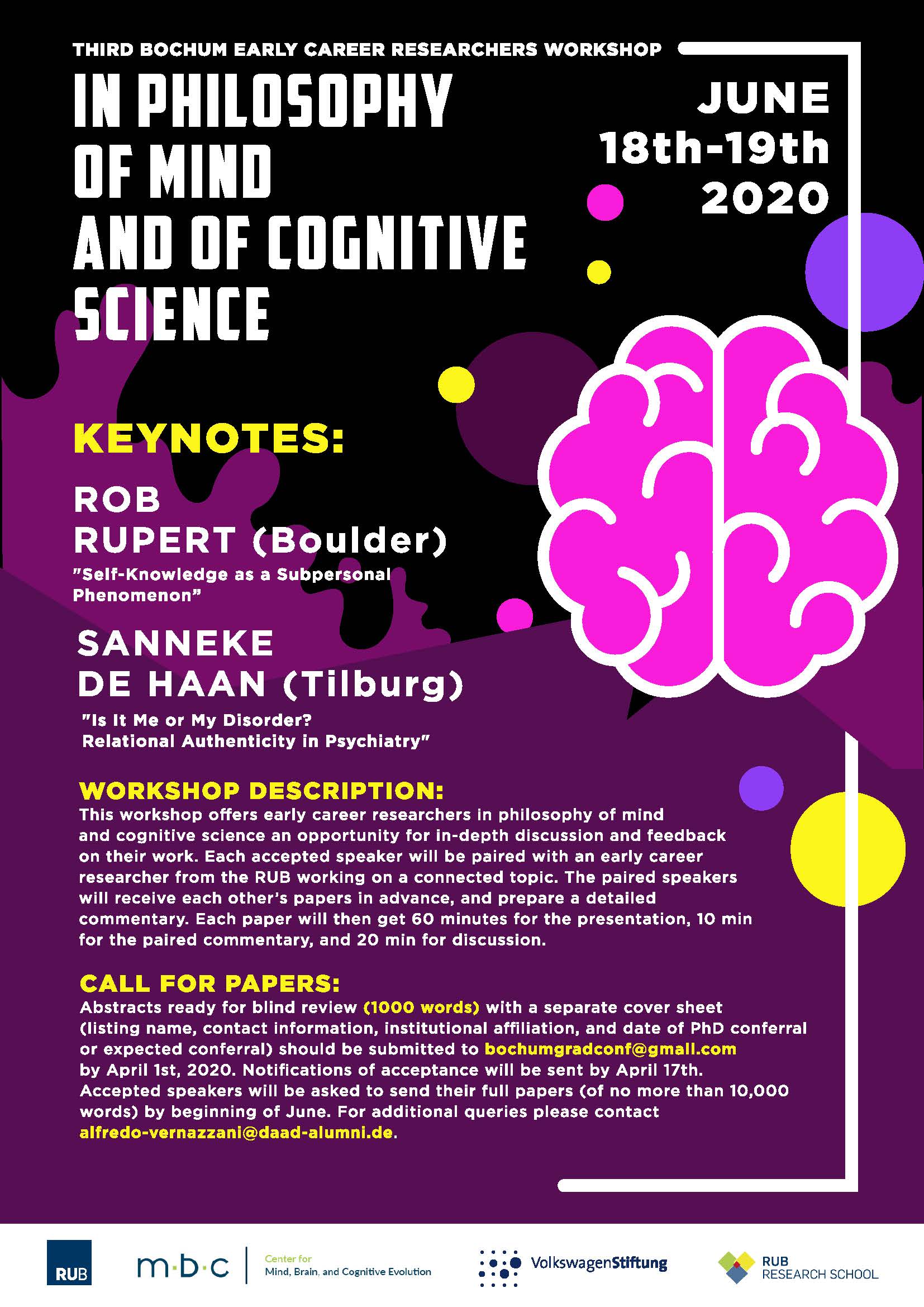
*please note that the details on the poster are not correct. Check the text below for current information
Platform and Registration
The event will be held using the Zoom platform over four consecutive weeks.
We would like to ask for registration before the event at the following email address:
alfredo-vernazzani@daad-alumni.de
Schedule
CET (i.e. Berlin\Amsterdam timezone)
12 JUNE
15:15 – 16:15 Alexander Miller Tate (KCL)
Title: Explaining agential pathology in clinical depression
16:15 – 17:15 Roy Dings (RUB)
Title: Meaningful affordances
17:15 – 18:15 Keynote: Sanneke de Haan (Tilburg)
Title: Is it me or my disorder? Relational authenticity in psychiatry
19 JUNE
15:15 – 16:15 Irena Dajić (Vienna)
Title: The Efficacy of Delusional Belief
16:15 – 17:15 Francesco Marchi (RUB)
Title: Spinozan Self-deception
26 JUNE
15:15 – 16:15 Michelle Liu (Hertfordshire)
Title: The Concept of Pain
16:15 – 17:15 Guido Robin Löhr (RUB)
Title: TBA
3 JULY
15:15 – 16:15 Sofiia Rappe (LMU)
Title: Thinking about Thought (and Predictive Processing)
16:15 – 17:15 Nina Poth (RUB)
Title: Predictive Processing as a unifying theory. In what sense?
17:15 – 18:15 Keynote: Rob Rupert(Boulder)
Title: Self-Knowledge as a Subpersonal Phenomenon

Dr. Anna Wehofsits (University of Munich)
09.06.2020 – 16.00 – 17.00 – (lecture, followed by an extended discussion)
Online Lecture via zoom
Login information:
Abstract:
If one understands self-deception in analogy to other-deception, the phenomenon appears paradoxical. Today most authors therefore argue that we should conceptually separate self-deception from other-deception. I share this view. However, it is usually overlooked that the practice of self-deception bears an interesting relationship to other-deception, which also raises conceptual and normative questions. Very often, self-deception affects not only the beliefs and behavior of the self-deceiving person, but also the beliefs and behavior of others, who may become (involuntary) accomplices in self-deception. As it seems, other-deception can support self-deception (and vice versa). It is, however, very difficult to describe this dynamic without contradictions. In my talk, I discuss the problems associated with different readings of the mutual support of self-deception and other-deception. I will show that proposals that help to resolve the tensions within the notion of self-deception do not also resolve the tensions that arise between self-deception and other-deception when trying to describe how they support each other.

What can we learn
about mineness
from dépersonnalisation?
Alexandre Billon (Department of Philosophy, University of Lille)
05.05.2020 – 16.00 – 17.00 – (lecture, followed by an extended discussion)
Online Lecture via zoom
Login information:
https://zoom.us/j/464004598?pwd=S2lWYytZTFNySWxPbjFKbGxHQlEwQT09
Meeting
ID: 464 004 598
Password: 004051
Abstract:
Patients suffering from
depersonalization complain of feeling detached from their body, their mental
states, and actions or even from themselves.
In this paper, I argue that
depersonalization consists in the lack of a phenomenal feature that marks my
experiences as mine, which is usually called “mineness”, and that the study of depersonalization constitutes a neglected yet
incomparable probe to assess empirically the scope, role, and even the nature of mineness.

Import Theory:
The Social Making of Consciousness
Wolfgang Prinz (Department of Psychology, Max Planck Institute for Human Cognitive and Brain Sciences)
23.06.2020 – 16.00 – 17.00 – (lecture, followed by an extended discussion)
Online Lecture via zoom
Login information:
Password: 000521
Abstract:
This talk outlines what I call an import theory of selfhood and consciousness. Import theory raises three major claims: (i) conscious awareness builds on self-representation; (ii) selfhood is a social, not a natural kind; (iii) selfhood is imported from others to self. While export theories offer a number of mechanisms to account for the putative transition from self to others, import theories have so far not much to offer for the putative transition in the reverse direction. A framework is outlined to close this gap. Key to the framework is the notion of action matching. This term addresses dyadic interactions for perception/action matching, that is, matching perception of foreign action to production of own action, and vice versa. The framework specifies both representational resources and social practices on which self-import through action matching is claimed to rely. A final commentary compares export and import theories in terms of explanatory power, claiming that import theories can explain key features of consciousness that export theories can only invoke.