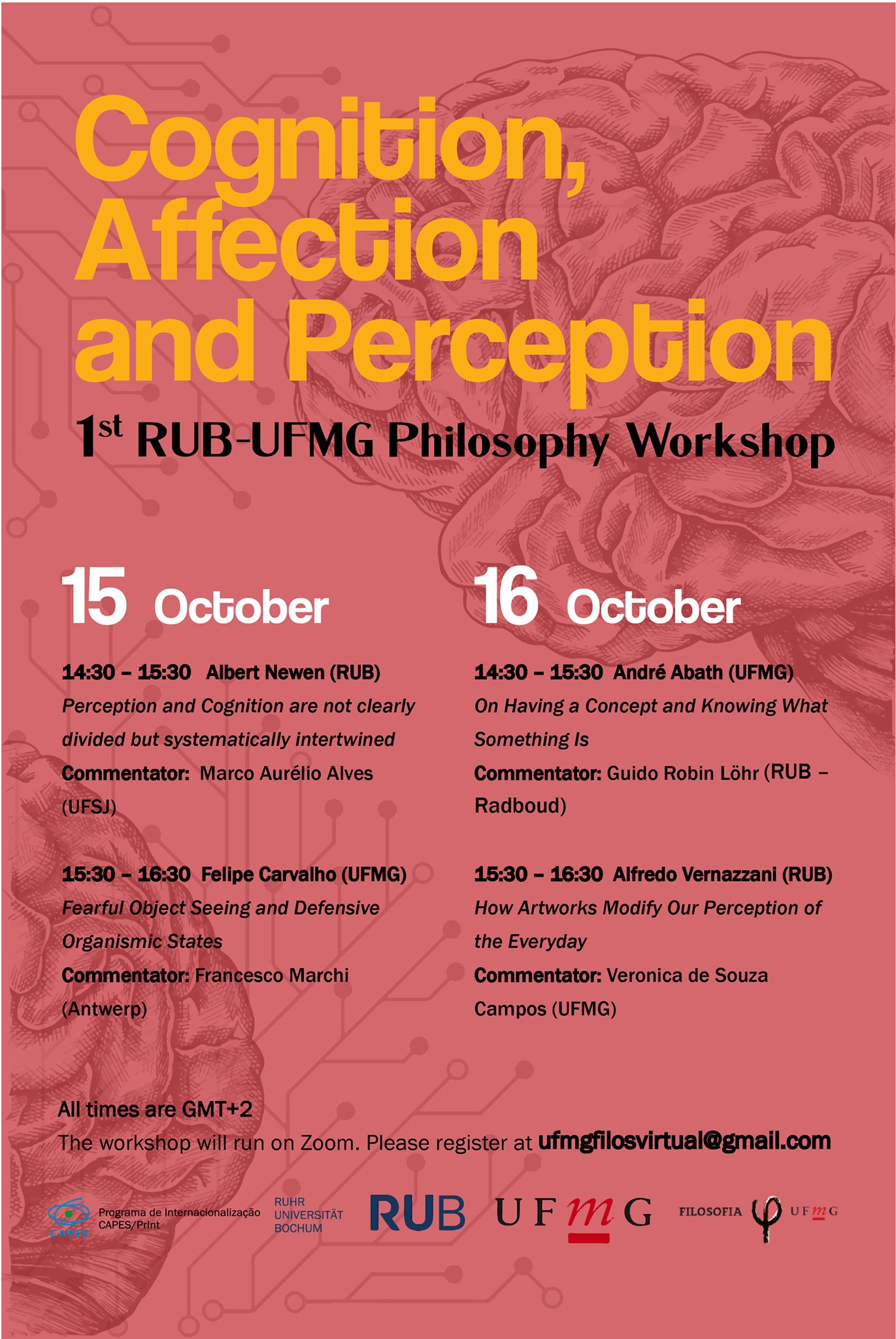
Description:
Our minds possess the capacity to perceive our surroundings (visually, acoustically, etc.), but also the capacity to think and cognize, and the capacity to feel and being emotionally affected. An interesting and much-debated question is how perception and cognition interact. Does cognition penetrate and alter our perceptual uptake of the environment? And if yes, how? Beside cognitive penetration, there is an intriguing and much-less discussed question of whether affective and emotional states pentrate and alter our perceptual experience.
Such questions constitute the main topics of the 1st RUB-UFMG Philosophy workshop. Philosophers from the Ruhr-Universität Bochum and from the Universidade Federal de Minas Gerais will discuss and comment each others works.
Schedule:
14:30 – 15:30 Albert Newen (RUB) – Perception and Cognition Are Not Clearly Divided but Systematically Intertwined
Commentator: Marco Aurélio Alves (UFSJ)
15:30 – 16:30 Felipe Carvalho (UFMG) – Fearful Object Seeing and Defensive Organismic States
Commentator: Francesco Marchi (Antwerp)
14:30 – 15:30 André Abath (UFMG) – On Having a Concept and Knowing What Something Is
Commentator: Guido Robin Löhr (RUB – Radboud)
15:30 – 16:30 Alfredo Vernazzani (RUB) – How Artworks Modify Our Perception of the Everyday
Commentator: Veronica de Souza Campos (UFMG)
All times are CET!
Where?
The workshop will run on Zoom.
Login information: https://ruhr-uni-bochum.zoom.us/j/93454573230?pwd=N2pXalEvV2JYbEpDaVp1eXVRQWtxdz09 (password 219732).
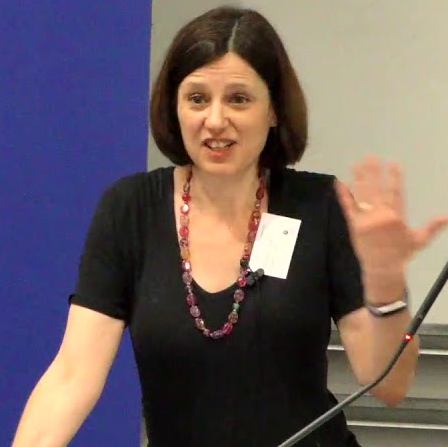
Marya Schechtman (University of Illinois)
We’ll always have Paris: Memory, affect, and personal identity.
12.11.2020, 16:15-17:45 CET (UTC+01:00).
Online Lecture via zoom.
Login information:
Zoom:
https://us02web.zoom.us/j/82970505769?pwd=NGpHL3VHUUg0bktTbnBIT2kxMWVYZz09
- meeting ID: 829 7050 5769
- password: 8rraW0
Abstract:
This paper explores an idea, commonly expressed in everyday life, that memories are “treasures” to be stored away and enjoyed later, cherished possessions, which are “ours forever”. The central task is to understand better what it is that people have in mind when they talk about memories in this way. What kinds of memories are they talking about? Why are they so cherished? I suggest that the relevant memories (1) are of events or life periods that we imbue with significance (2) are likely to involve and evoke powerful affect, and (3) that the value associated with these treasured memories is closely connected to the complicated role they can play in regulating mood and emotion. I argue also that the way in which they influence affect generates an experience of both diachronic continuity and discontinuity and hence of ourselves as continuing, multifaceted beings. Understanding how this is so helps to illuminate the often-suggested connection between memory and personal identity.
James Openshaw (University of Warwick)
Remembering objects and imagining the past.
05.11.2020, 10:00-11:30 CET (UTC+01:00).
Online Lecture via zoom.
Login information:
Zoom:
https://us02web.zoom.us/j/82970505769?pwd=NGpHL3VHUUg0bktTbnBIT2kxMWVYZz09
- meeting ID: 829 7050 5769
- password: 8rraW0
Abstract: Taxonomies of memory typically come with ontological baggage. Episodic memory supports the recollection of experienced events, semantic memory of facts, and so on. Where does the recollection of objects fit into this picture? Of course, one can recall an object by episodically recalling event in which it featured, or perhaps by recalling certain facts about it. Are these possibilities exhaustive? Or might there be distinctive kinds of conscious occurrence which put one in a position to have singular thoughts about past objects? In this talk I’ll explore a challenge for the view that recalling an object (in such a way as to support past-tensed singular thought about it) requires episodically recalling an event in which that object featured. I will then consider what an alternative, ‘non-reductive’ view of object memory might look like.

Johannes Mahr (Harvard University)
What is the function of episodic memory?
29.10.2020, 16:15-17:45 CET (UTC+01:00)
Online Lecture via zoom
Login information:
Zoom:
https://univ-grenoble-alpes-fr.zoom.us/j/95146807125?pwd=TWpMSDVCdVJ6cmVkVGVnUVFPZjRvUT09
- meeting ID: 951 4680 7125
- password: 631879
Abstract:
Accounts of episodic memory function differ according to whether they target ‘memory’ or ‘remembering’. While ‘memory’ refers to the capacity to encode, store, and retrieve information (a ‘preservative’, ‘diachronic’ activity), ‘remembering’ describes the psychological activity of generating a representation about the past in the present (a ‘generative’, ‘synchronic’ activity). Based on this distinction, I will argue that an account of episodic memory function needs to be an account of the function of ‘remembering’ rather than ‘memory’. Such an account, however, requires us to proceed from ‘form’ to ‘function’; that is, it requires us to first specify the features of the kind of representations that remembering generates before we can ask why it might do so. After providing a characterization of the representational structure of remembering I will evaluate whether the most common views of episodic memory function can account for its form. It will turn out that neither preservationism (the idea that episodic memory must be for recalling the past), nor simulationism (the ideat that episodic memory must be for imagining the future) can adequately account for the representational structure of remembering. Instead, I will propose an alternative account according to which remembering functions to stabilize human communication about the past.

Katherine Puddifoot (Durham University)
Mnemonic injustice.
22.10.2020, 10:00-11:30 CEST (UTC+02:00)
Online Lecture via zoom
Login information:
Zoom: https://us02web.zoom.us/j/82970505769?pwd=NGpHL3VHUUg0bktTbnBIT2kxMWVYZz09
- meeting ID: 829 7050 5769
- password: 8rraW0

Peter Langland-Hassan (University of Cincinnati)
What sort of imagining might remembering be?
15.10.2020, 16:15-17:45 CEST (UTC+02:00)
Online Lecture via zoom
Login information:
Zoom:
https://us02web.zoom.us/j/82970505769?pwd=NGpHL3VHUUg0bktTbnBIT2kxMWVYZz09
- meeting ID: 829 7050 5769
- password: 8rraW0