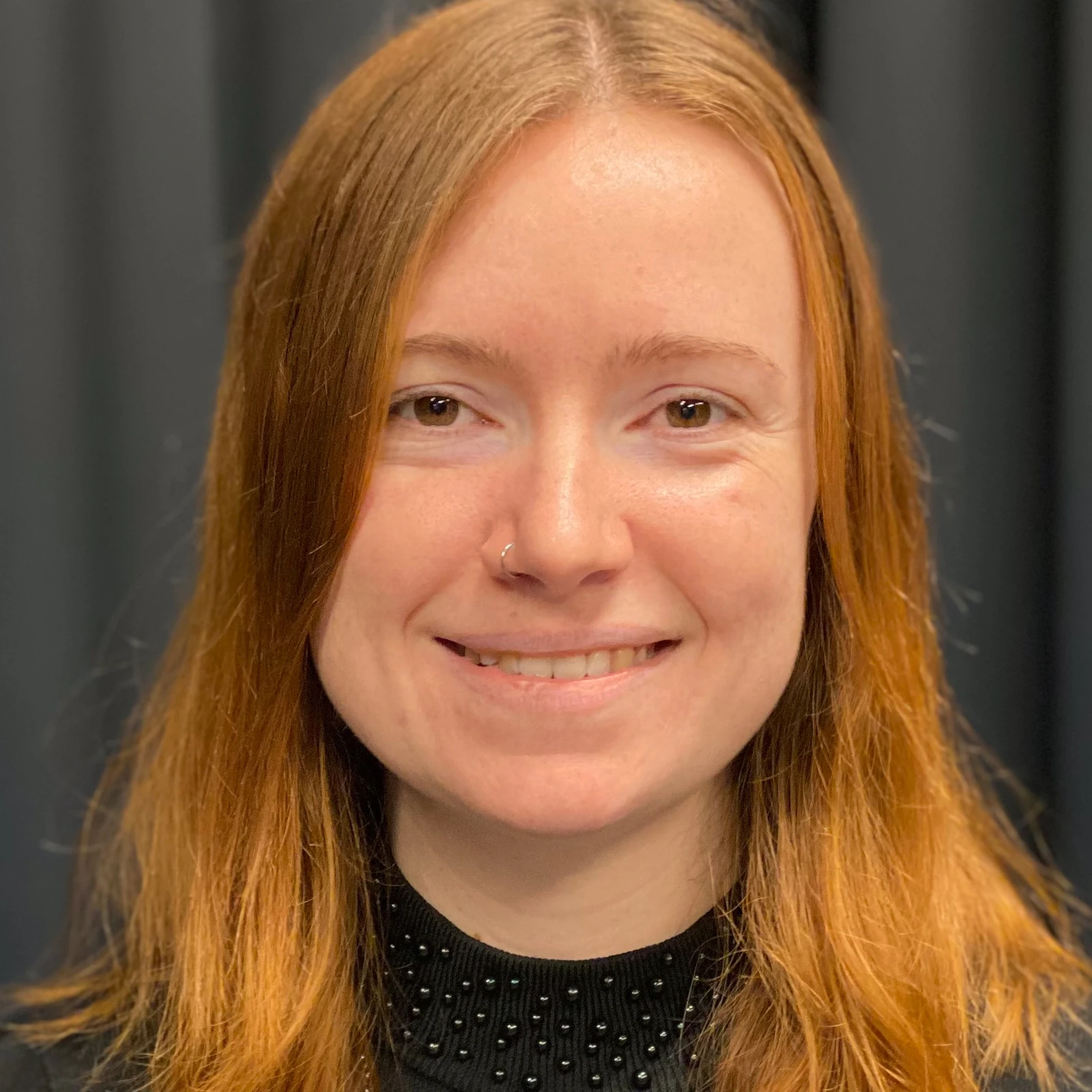
Katie Winkle, PhD [Host: Prof. Dr. Tobias Schlicht] Time: November 2023
Katie Winkle is Assistant Professor of Social Robotics in the Department of Information Technology at Uppsala University. The work of her team is focused on trustworthy human-robot interaction. She completed her PhD at the FARSCOPE centre for doctoral training at the Bristol Robotics Laboratory. The thesis has the title “Expert-Informed Design and Automation of Persuasive, Socially Assistive Robots”. Two representative articles are:
More information about her and her work: https://kwinkle.github.io
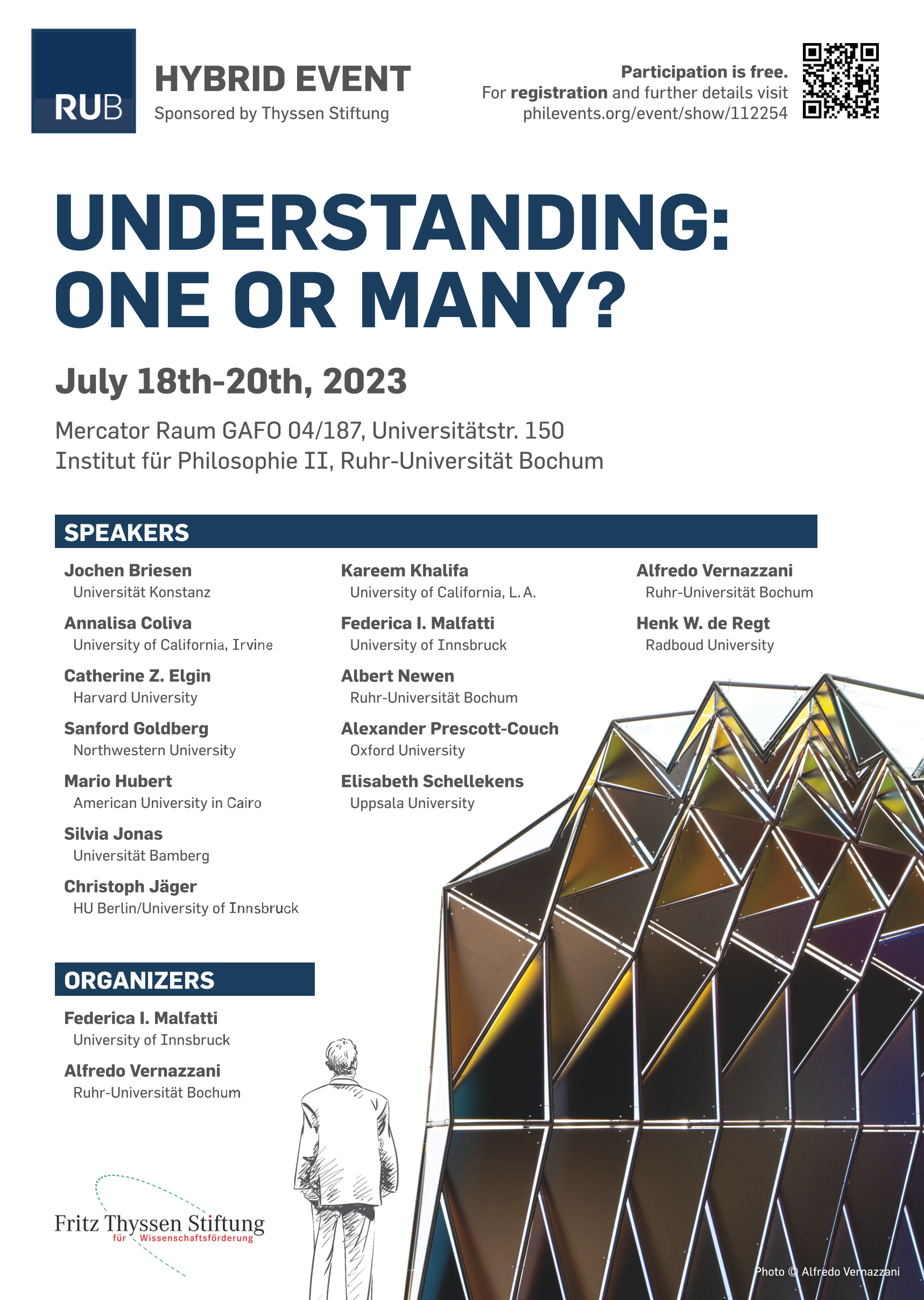
18. – 20.07.2023
Institut für Philosophie II, Ruhr-Universität Bochum
Mercator Raum GAFO 04/187
Description
While understanding has recently become the object of intense debate among philosophers, it remains an open question how to make sense of different forms of understanding. These include scientific understanding (e.g. understanding scientific theories, phenomena, models, etc.), moral understanding (e.g. understanding other people, understanding political subjects, etc.), aesthetic understanding (e.g. understanding an artwork, like a novel or painting, and how these enable us to understand the world), or religious understanding (e.g. understanding theology, understanding and our spiritual life).
The main goal of the conference is to gather some of the most prominent, established researchers in the field of understanding, as well as early career researchers, to debate about the nature of understanding and what connections there may be between scientific, moral, aesthetic, and religious understanding.
Registration
This is a hybrid event, participation online or in person is free, but please register first by sending an e-mail with your name, e-mail address, and preference (online or in-presence participation) to:
alfredo-vernazzani@daad-alumni.de
or
fede.malfatti89@gmail.com
Seats are limited for in-presence participation!
A Zoom link will be sent to all registered participants on July 17.
Program
(All times are CET!)
18.07.2023
8:45 – 9:00 opening
9:00 – 10:15 Catherine Z. Elgin (Harvard): “Epistemic Agency”
10:15 – 11:30 Christoph Jäger (Innsbruck/HU): “Socratic Authority and Understanding”
11:30 – 12:00 Coffee break
12:00 – 13:15 Silvia Jonas (Bamberg): “A Mathematical Perspective on Religious Understanding”
13:15 – 15:00 Lunch break
15:00 – 16:15 Alexander Prescott-Couch (Oxford): “Two Kinds of Political Understanding”
16:15 – 16:45 coffee break
16:45 – 18:00 Sanford Goldberg (Northwestern) & Kareem Khalifa (UCLA): “A Social Epistemology of Scientific Understanding”
19:30 Conference dinner
19.07.2023
8:45 – 9:00 opening
9:00 – 10:15 Annalisa Coliva (Irvine): “Wittgenstein and Morphology” (tentative title)
10:15 – 11:30 Alfredo Vernazzani (RUB): “Seeing-As, Memory, and Perceptual Intelligibility” 11:30 – 12:00 coffee break
12:00 – 13:15 Albert Newen (RUB): “Multiple Types of Social Understanding and their Underlying Dimensions”
13:15 – 15:00 Lunch break
15:00 – 16:15 Elisabeth Schellekens (Uppsala): “Aesthetic Experience and Epistemic Gain: The Case for Intelligible Aesthetic Value”
16:15 – 16:45 Coffee break
16:45 – 18:00 Jochen Briesen (Konstanz/FU): “Response-Dependence, Knowledge, and Understanding”
20.07.2023
8:45 – 9:00 opening
9:00 – 10:15 Mario Hubert (AUC) & Federica Isabella Malfatti (Innsbruck): “Understanding Quantum Mechanics”
10:15 – 10:30 coffee break
10:30 – 11:45 Henk de Regt (Radboud): “The Prospects of Artificial Scientific Understanding”
11:45 – 12:00 Conference ends
Speakers:
Jochen Briesen
Universität Konstanz
Annalisa Coliva
University of California, Irvine
Catherine Elgin
Harvard University
Sanford Goldberg
Northwestern University
Mario Hubert
American University in Cairo
Silvia Jonas
Universität Bamberg
Christoph Jäger
University of Innsbruck
Kareem Khalifa
University of California, Los Angeles
Federica Isabella Malfatti
University of Innsbruck
Albert Newen
Ruhr-Universität Bochum
Alexander Prescott-Couch
Oxford University
Elisabeth Schellekens
Uppsala University
Alfredo Vernazzani
Ruhr-Universität Bochum
Henk W. de Regt
Radboud University
Organisers:
Federica Isabella Malfatti
University of Innsbruck
Alfredo Vernazzani
Ruhr-Universität Bochum
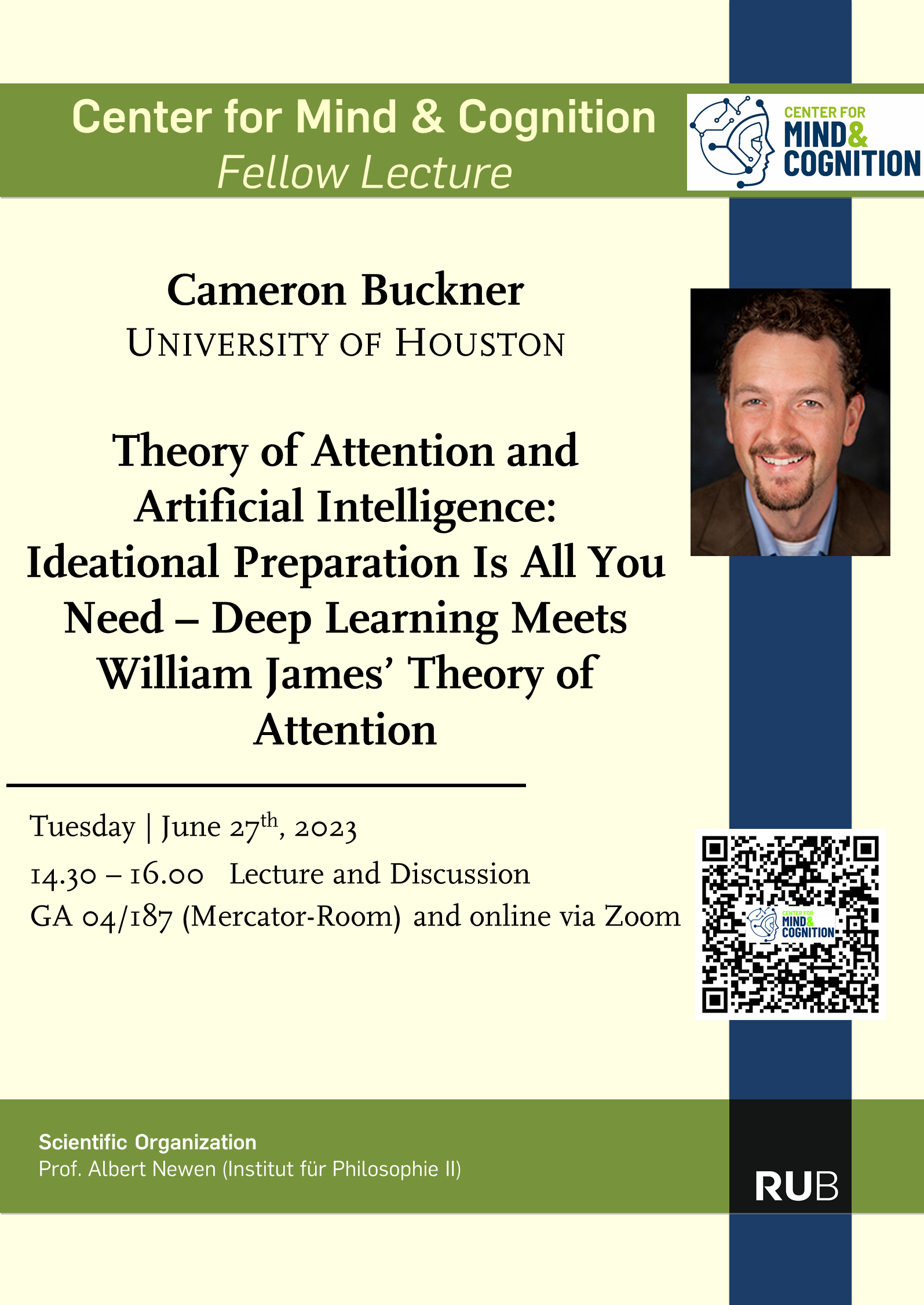
Tuesday, 27.6.2023: 14.30-16.00 Uhr,
Location (hybrid): GA 04/187 Mercatorraum und online via Zoom:
https://us02web.zoom.us/j/89147315543?pwd=aTNPMzdJdkhZbFluUXJKeHp5emVNQT09
Prof. Cameron Buckner, University of Houston (USA)
Fellow-Lecture
Theory of Attention and Artificial Intelligence: Ideational Preparation Is All You Need – Deep Learning Meets William James’ Theory of Attention
Abstract: Deep learning is a research area in computer science that has over the last ten years produced a series of transformative breakthroughs in artificial intelligence—creating systems that can recognize complex objects in natural photographs as well or better than humans, defeat human grandmasters in strategy games such as chess, Go, or Starcraft II, create bodies of novel text that sometimes are indistinguishable from those produced by humans, and predict how proteins will fold more accurately than human microbiologists who have devoted their lives to the task. The artificial neural network approach behind deep learning is usually aligned with empiricist theories of the mind, which can be traced back to philosophers such as Locke and Hume.
Contemporary rationalists like Gary Marcus and Jerry Fodor have criticized the innovations behind some of these breakthroughs, because they appeal to innate structure which is supposed to be off-limits to empiricists. I argue that these innovations are consistent with historical empiricism, however, as they implement roles attributed to domain-general psychological faculties like perception, memory, imagination, and attention, which were frequently invoked by paradigm empiricists in their explanations of the mind’s ability to extract abstractions from sensory experience. Computer scientists may benefit by reviewing these philosophers’ accounts of these faculties, for they anticipated many of the coordination and control problems that will confront deep learning theorists as they aim to bootstrap their models to greater levels of cognitive complexity using more ambitious
architectures with multiple interacting faculty modules. In this talk, I focus on William James’ account of attention in the Principles of Psychology by comparing the roles he assigned to attention in the extraction of abstract knowledge from experience to the innovations behind many recent architectures in deep learning. Despite numerous alignments, I argue that deep learning still has much to gain by considering other aspects of James’ theory which have not yet been fully implemented, especially the “ideational preparation” component of his theory, which aligns more naturally with predictive processing accounts of cognition.
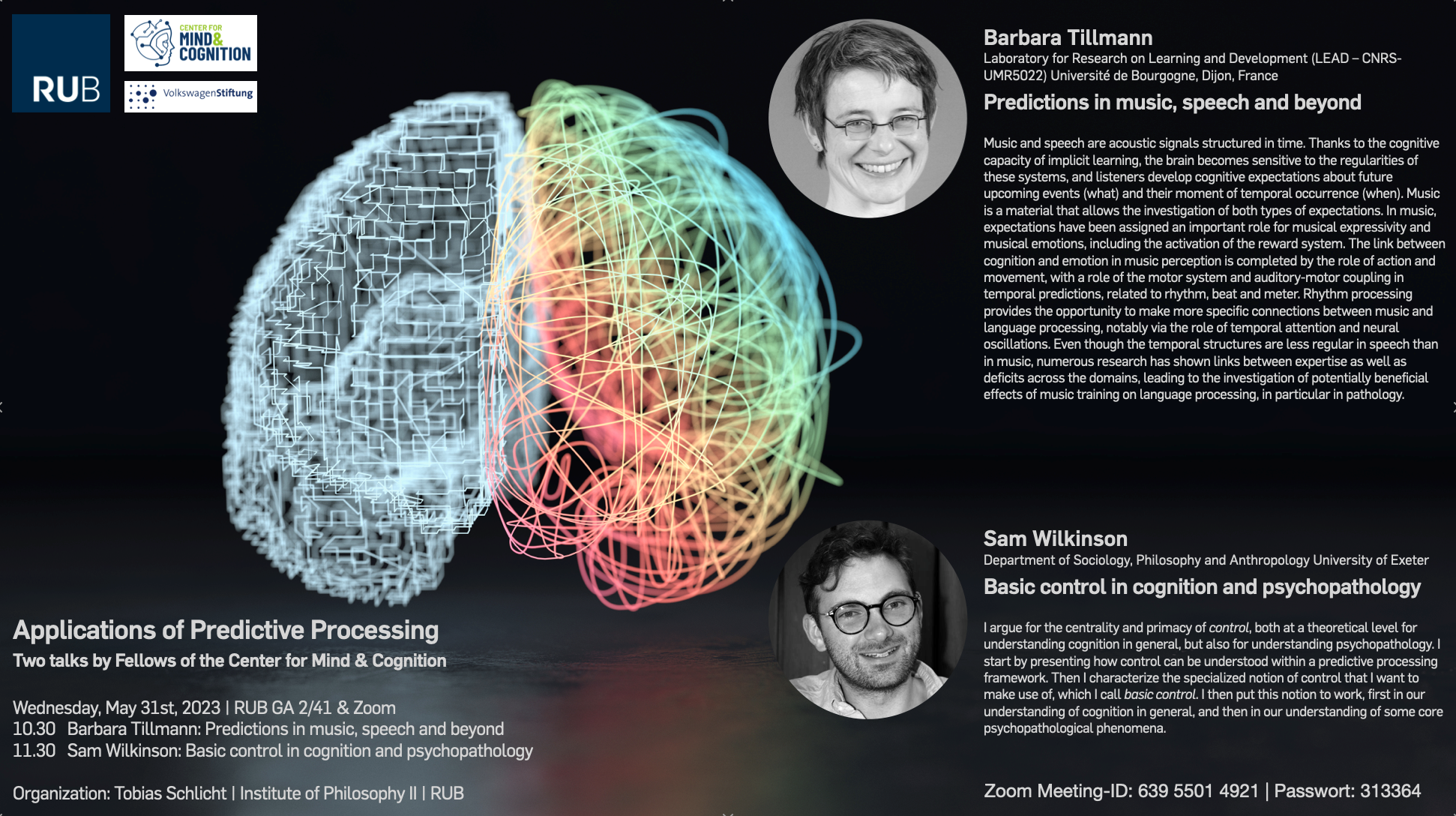
10:30: Barbara Tillmann (Laboratory for Research on Learning and Development, Université de Bourgogne
Predictions in music, speech and beyond
11:30: Sam Wilkinson (Department of Sociology, Philosophy and Anthropology, University of Exeter
Basic control in cognition and psychopathology
31st May 2023 in GA 2/41 and online
https://ruhr-uni-bochum.zoom.us/j/63955014921?pwd=VWIzN0hBMzkybDBkQmNFRmZHQ01EQT09
Meeting-ID: 639 5501 4921
Passwort: 313364