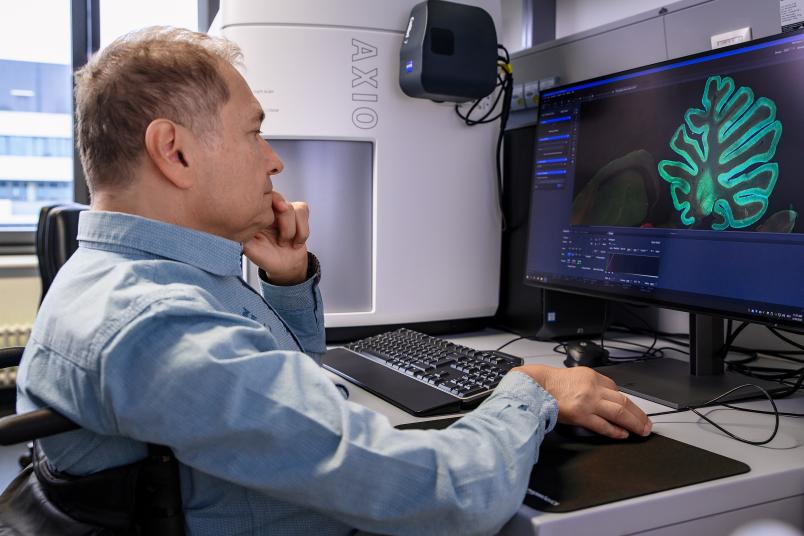
Rubin Special Edition “Extinction Learning” published
All about the work of the Collaborative Research Center 1280.
Do you know this too? You get a new PIN for your debit card, memorize it at home, but then stand in front of the ATM and all that comes to mind is your old PIN. This is because your brain still associates your old PIN with this place. Presumably a bearable problem if it’s only about withdrawing money. However, if you have learned to associate neutral experiences with fear and cannot get rid of it, this can have serious consequences. The reason is that relearning – also known as extinction learning – does not work properly.
The team from the Collaborative Research Center 1280 “Extinction Learning” investigates what happens in the brain during extinction learning, why context is crucial and what this means for overcoming fear and pain. The researchers report on their work in a special edition of the science magazine Rubin. It was published on January 7, 2025 and is available online.
A Small but Powerful Brain
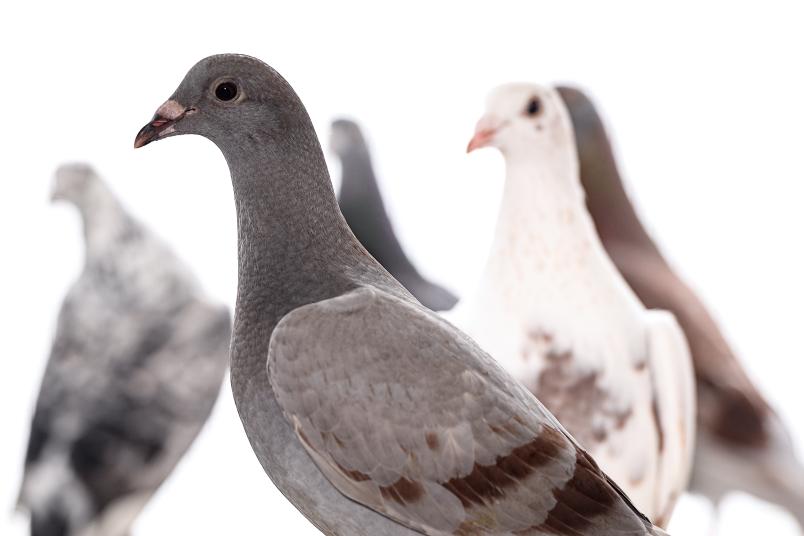
Pigeons are hard-working learners. And quite clever. A stroke of luck for the Bochum biopsychologists, who, thanks to them, are making advances into the fundamental mechanisms of extinction learning.
A yellow square lights up. Peck! The pigeon hits the glowing square with its beak. Shortly after, a flap at its feet opens up and releases a food pellet, which disappears into its beak in an instant. With the aid of rewards of this kind, pigeons quickly learn to associate the reaction to an actually neutral stimulus such as the illuminated square with a positive outcome. The Biopsychology research group at Ruhr University Bochum, however, is above all interested in what happens when the birds have to relearn, i.e. if the yellow square suddenly no longer results in a reward. The mechanisms of this extinction learning are the focus of Collaborative Research Center 1280.
Unlike in many other experiments, Bochum biopsychologists Dr. Roland Pusch and Professor Onur Güntürkün work with birds instead of mice, rats, or humans. “We are studying an animal whose last shared ancestor with these three species lived 324 million years ago: the pigeon,” explains Onur Güntürkün. The reason for this is simple: Pusch and Güntürkün are searching for the fundamental components of extinction learning that should even be the same in species far distant from humans from an evolutionary perspective.
For full article, visit RUB News
The Value of Curiosity
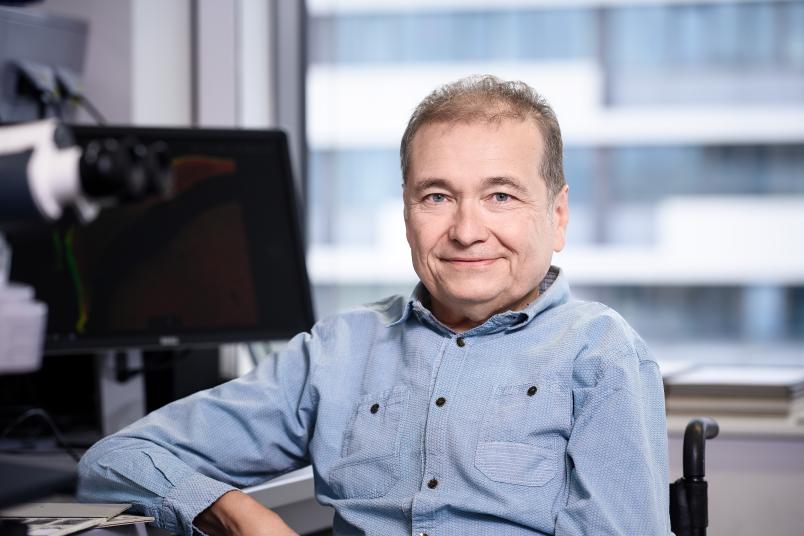
Fundamental research: Many people in academia are concerned with the pursuit of knowledge, without an explicit application in mind. Is that a good thing? A commentary by Onur Güntürkün.
Many researchers are familiar with this situation: They are asked what they are working on, talk about their project and then hear the question: What is it good for? I too am familiar with this situation. My research group is interested in how the brains of birds and humans work and how behavior arises. Like many other basic researchers, we cannot answer the question about the meaning of our work by claiming that we want to cure a disease, stop climate change or develop a new product for industry. We do research to gain knowledge. Does that make sense? Yes, it does.
For full article, visit RUB News

What Makes Places Lonely?
In an ERC Consolidator Grant, Maike Luhmann is exploring how places relate to loneliness. She also hopes to find out how loneliness can be combated.
Are there any places where people feel particularly lonely or where they don’t feel lonely at all? Professor Maike Luhmann argues that the relationship between place and loneliness should be described in dynamic terms. What one person finds lonely, another may find inviting. A place that seems desolate to one person on one day may seem completely different on another day or at another time. In her project “Loneliness Across Time And Space” (LOTIS), Luhmann, a professor of psychological methods at Ruhr University Bochum, Germany, is putting this dynamic relationship into a new theoretical framework, while incorporating people’s mobility patterns at the same time. The project is funded by the European Research Council ERC with a Consolidator Grant of approximately 2 million euros over five years.
For the full article, visit RUB News

27 Professors Already Appointed
The University Alliance Ruhr continues to expand its cutting-edge research in Duisburg-Essen, Bochum, and Dortmund.
The four Research Centers and the College of the University Alliance Ruhr (UA Ruhr) form a new research hub in the Ruhr area. Twenty-seven international top scientists have already chosen a future within the UA Ruhr and thus at one of the three partner universities: Ruhr University Bochum, TU Dortmund University, or the University of Duisburg-Essen. In total, more than 50 new research professorships are being created within the centers and the college.
Some of the center researchers are part of the new hub: Lucia Melloni, Caspar Schwiedrzik.
For the full article, visit RUB News