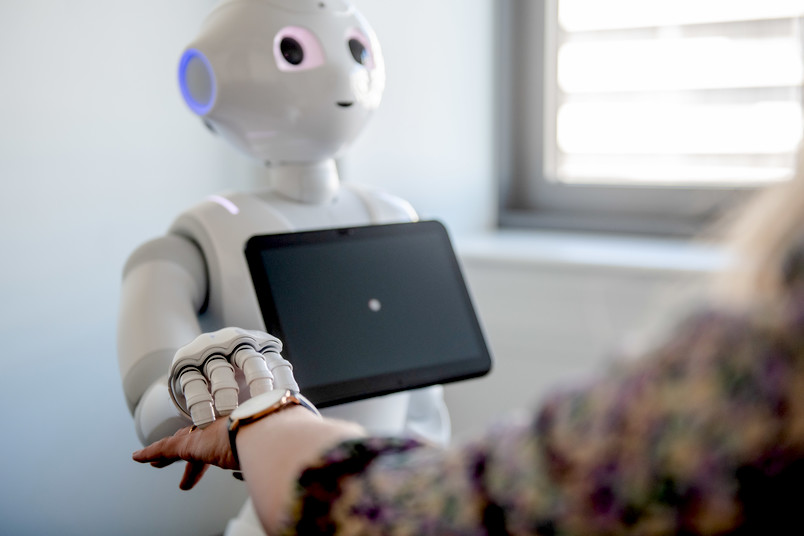
Wie wir mit intelligenten Systemen kommunizieren und interagieren
Künstliche Intelligenz (KI) boomt und wird unsere soziale Interaktion intensiv prägen. Was macht das mit uns?
Messenger-Dienste, Chatbots, Roboter-Kolleg*innen: Wir interagieren in unserem Alltag schon lange nicht mehr nur mit Menschen. Welche Veränderungen bringt diese Entwicklung mit sich? Wie gestalten wir sie? Und welche Gefahren, aber auch Chancen sind damit verbunden? Mit dieser Thematik befasst sich der Forschungsverbund „INTERACT! Neue Formen der sozialen Interaktion mit intelligenten Systemen“ an der RUB, der durch das Ministerium für Kultur und Wissenschaft des Landes Nordrhein-Westfalen mit 2 Millionen Euro gefördert wird. Team
Menschen sind interaktive Wesen: Gemeinsames Leben, soziale Verständigung und kooperatives Handeln zeichnen uns aus, was gerade in der Pandemie den Alltag so schwermacht, wenn soziale Begegnungen auf ein Minimum reduziert werden müssen. „Eine zentrale Herausforderung für die moderne Gesellschaft ist die Veränderung unserer Interaktion über soziale Medien und mit Systemen Künstlicher Intelligenz. Dabei sehen wir neue Risiken, aber auch unerwartete Chancen“, sagt Tobias Schlicht.
Mit dem Siegeszug von Internet und Smartphone sind in fast allen Gesellschaften neue Formen der Kommunikation entstanden, vor allem über soziale Medien. KI-Technologien erfahren einen Entwicklungsboom. Sprachassistenten, Roboter und andere KI-basierte Systeme werden in viele Bereiche des Lebens integriert und prägen zunehmend die soziale Interaktion, zum Beispiel in Pflege- und in Bildungseinrichtungen sowie Unternehmen.
Zentrale Aspekte der sozialen Interaktionsforschung
Diese Entwicklungen bringen praktische Möglichkeiten und Herausforderungen mit sich und werfen theoretische wie ethische Fragen auf. Was sind die zentralen Prinzipien, die eine persönliche Mensch-Mensch-Interaktion bestimmen und wie verändern sie sich durch verstärkte Kommunikation über soziale Medien? Wie sollen wir diese KI-Systeme einschätzen? Wie können wir die Interaktion und Kooperation zwischen Menschen und KI-Systemen in pädagogischen und Arbeitskontexten am besten gestalten und steuern?
Diesen und anderen Fragen widmet sich das Team von sechs Forscherinnen und Forschern aus den Geistes-, Sozial- und Verhaltenswissenschaften an der RUB.
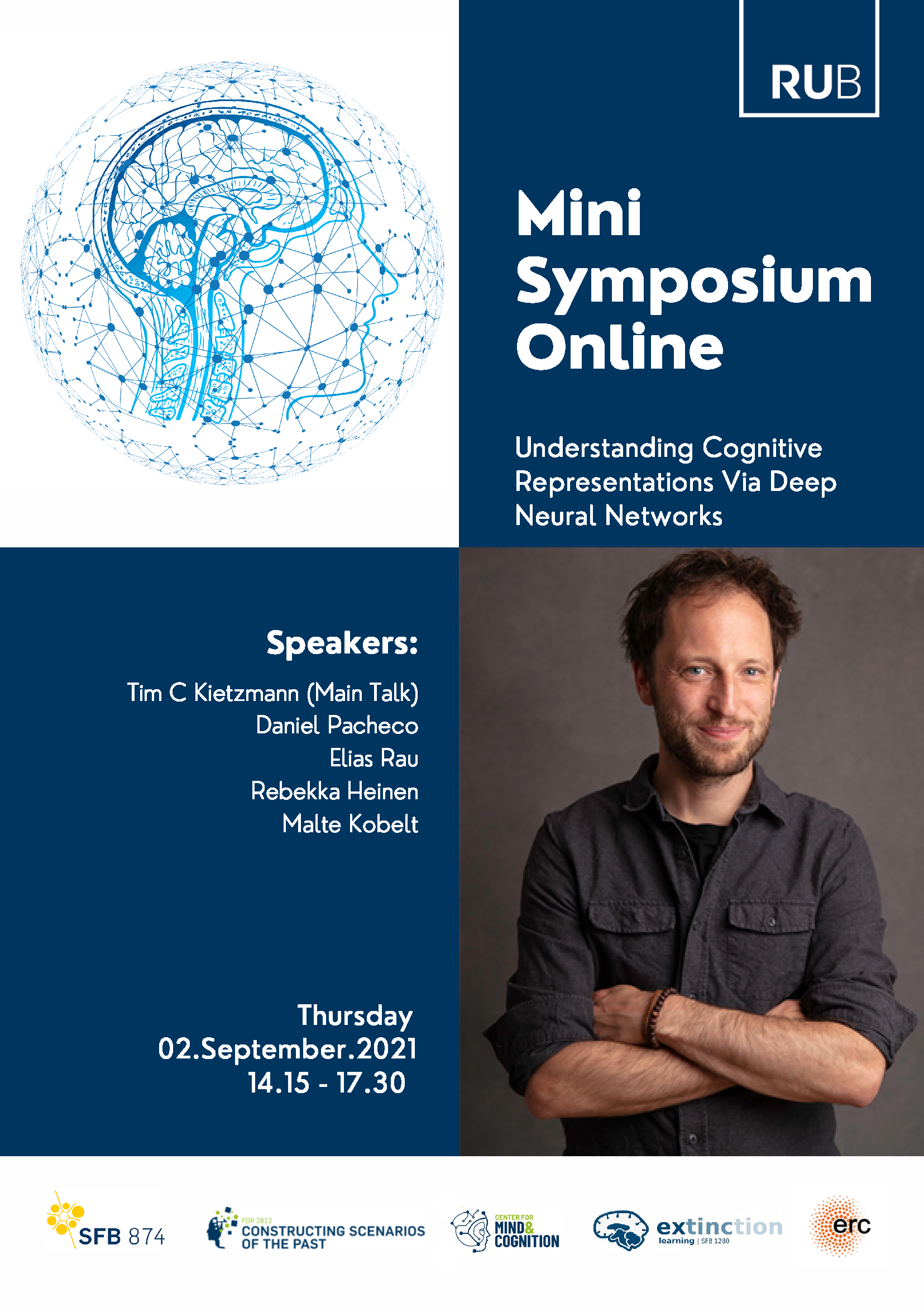
Understanding cognitive representations via deep neural networks
September 2nd 2021
2.15 p.m. – 5.30 p.m.
Einwahldaten für zoom:
Zoom-Meeting beitreten
https://ruhr-uni-bochum.zoom.us/j/63379523780?pwd=aFpSd3BCMnU3WG82TXc3Sk9sWUZVZz09
Meeting-ID: 633 7952 3780
Passwort: 650527
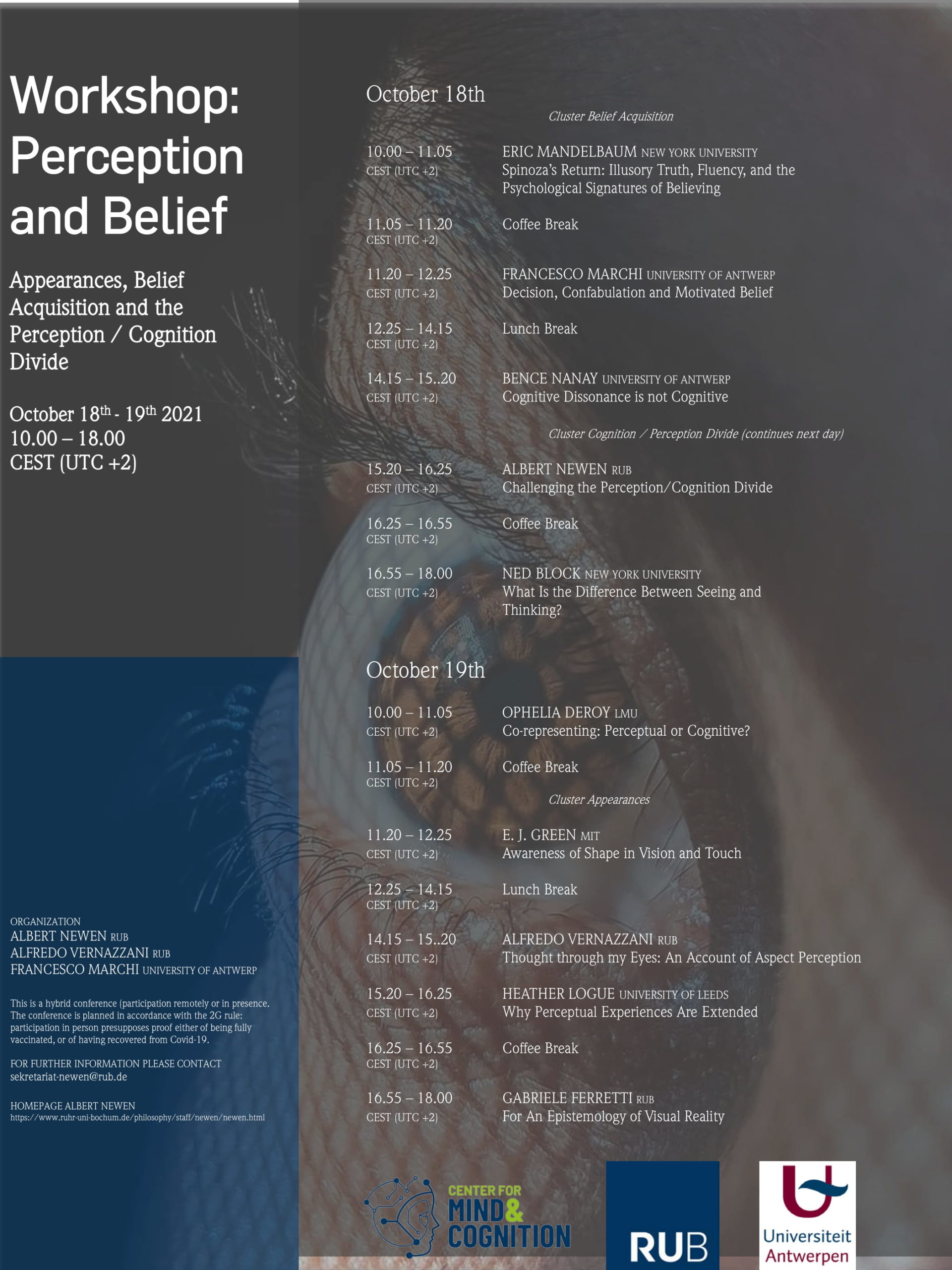
October 18th – 19th 2021
10.00 – 18.00
CEST (UTC +2)
ORGANIZATION
ALBERT NEWEN RUB
ALFREDO VERNAZZANI RUB
FRANCESCO MARCHI UNIVERSITY OF ANTWERP
FOR FURTHER INFORMATION PLEASE CONTACT
sekretariat-newen@ruhr-uni-bochum.de

20 September
14:30 – 15:30 Albert Newen (RUB) – The ALARM theory of consciousness: a two-level theory of phenomenal consciousness.
Commentator: Carlos Barth (UFMG)
15:30 – 16:30 Daniel Debarry (UFMG) – Rational capacities in perception
Commentator: Alfredo Vernazzani (RUB)
21 September
14:30 – 15:30 Ernesto Perini (UFMG) – Thinking about (and beyond) ‘you’
Commentator: Julia Wolf (RUB)
15:30 – 16:30 Sabrina Coninx (RUB) – A Multidimensional phenomenal space for pain: structure, primitiveness, and utility
Commentator: Marco Aurelio Sousa Alves (UFSJ)
The workshop will take place online. All are welcome, but please register by sending an email at the following adress:
ufmgfilosvirtual@gmail.com
We will then send you the Zoom link.

The German Society for Cognitive Science (GK) would like to support students who find themselves in a difficult (emergency) situation caused by the Corona pandemic with a bridging grant.
The grant consists a funding for maximum of three months á 500 € per month. The GK is able to offer six to eight grants. The grant is meant as financial support allowing to finish the respective degree (Bachelor or Master) or providing some financial relief during an important PhD thesis phase (e.g. finishing a paper). The selection will be done by the members of the steering committee of the German Society for Cognitive Science (GK).
The committee will consider all emergency cases as long as they have been caused by the Corona pandemic within the context of the studies and/or doctoral programme and are sufficiently substantiated with proof.
The application shall be emailed with the subject „Application Bridging Grant“ to the following email:
Chair of the GK, Prof. Dr. Barbara Kaup, barbara.kaup@uni-tuebingen.de;
Application deadline: 15.10.2021
Below you’ll find detailed information on the conditions of the stipend and how to apply (in English and German):
„Bridging grant”
from the German Society for Cognitive Science (GK) for BA-, MA- and PhD students
The German Society for Cognitive Science (GK) would like to support students who find themselves in a difficult (emergency) situation caused by the Corona pandemic with a bridging grant.
The grant consists a funding for maximum of three months á 500 € per month. The GK is able to offer six to eight grants. The grant is meant as financial support allowing to finish the respective degree (Bachelor or Master) or providing some financial relief during an important PhD thesis phase (e.g. finishing a paper). The selection will be done by the members of the steering committee of the German Society for Cognitive Science (GK).
The committee will consider all emergency cases as long as they have been caused by the Corona pandemic within the context of the studies and/or doctoral programme and are sufficiently substantiated with proof.
Target group: This funding is intended for students who are enrolled and/or registered in a German university. In particular, only the following persons are eligible for funding: (1) Bachelor or Master students in subjects belonging to Cognitive Science (e.g. Cognitive Science, Philosophy, Psychology, Informatics, AI, Linguistics, Neuro Sciences) who, ideally, will be able to graduate soon, and (2) PhD students registered in one of the subjects belonging to Cognitive Science who are working on a cognitive science project. Persons who already received a bridging grant from the GK are not eligible to apply.
Paradigmatic cases: A student pursuing a Master degree has fallen behind with their master thesis because due to the Corona-pandemic there was no constant childcare. The funding could be used to pay for a privately organised childcare. A PhD student could not finish his or her dissertation because data acquisition was delayed due to reduced lab capacities. The funding could be used to cover living expenses after the contract has expired.
Application and Proof:
To submit:
- a statement comprehensibly describing applicant’s situation (cases with evidence are preferred) and indicating the use of the funding.
- BA and MA students:
o Enrolment confirmation and Transcript of Record
o A letter from the faculty’s/program’s advisor confirming the regular continuation of studies, anticipated graduation (within the winter term 2021/2022) - PhD students:
o A short statement from the first supervisor roughly sketching the cognitive science related project and describing the project’s progress
The application shall be emailed with the subject „Application Bridging Grant“ to the following email: Chair of the GK, Prof. Dr. Barbara Kaup, barbara.kaup@uni-tuebingen.de;
Application deadline: 15.10.2021
„Überbrückungsstipendium“
der Gesellschaft für Kognitionswissenschaft für Studierende und Promovierende
Die Gesellschaft für Kognitionswissenschaft e.V. möchte Studierende, die durch die Corona Pandemie in eine Notsituation gekommen sind, mit einem Überbrückungsstipendium unterstützen.
Das Stipendium umfasst eine Förderung von maximal drei Monaten á 500 €. Die GK hat die Möglichkeit, sechs bis acht Stipendien zu vergeben.
Das Stipendium soll dabei helfen, entstandene Engpässe zu beheben und somit den Abschluss des Studiums (Bachelor bzw. Master) zu ermöglichen oder auch eine wichtige Phase der Dissertation zu unterstützen (z.B. Abschluss eines Artikels).
Das Auswahlgremium besteht aus dem Vorstand der Gesellschaft für Kognitionswissenschaft e.V.
Das Gremium steht allen Arten von Notfallsituationen offen gegenüber, solange diese im Kontext des Studiums / der Promotion durch die Pandemie verursacht sind und glaubhaft nachgewiesen wird.
Zielgruppe: Die Förderung ist für Studierende und Promovierende gedacht, die an einer Universität in Deutschland eingeschrieben sind. Genauer: Förderungswürdig sind nur Bachelor- und Masterstudierende in einem kognitionswissenschaftlichen Fach (z.B. Kognitionswissenschaft, Philosophie, Psychologie, Informatik, KI, Linguistik, Neurowissenschaften), deren Abschluss idealerweise bald erreicht werden kann, sowie Promovierende in einem solchen Fach, die ein kognitionswissenschaftliches Projekt bearbeiten. Personen, die bereits ein Überbrückungsstipendium der GK erhalten haben, können nicht erneut gefördert werden.
Fallbeispiele: (1) Eine Studierende, die den Masterabschluss anstrebt, ist mit dem Schreiben der Masterarbeit in Verzug geraten, da durch die Corona-Pandemie die Kinderbetreuung weiterhin nicht konstant gewährleistet ist und die Kinderbetreuung selbst übernommen werden muss. Die Förderung kann für privat organisierte Kinderbetreuung eingesetzt werden. (2) Eine Promovierende, die ihre Doktorarbeit nicht abschließen kann, weil wichtige Daten wegen der eingeschränkten Laborkapazitäten bislang nicht erhoben werden konnten. Die Förderung kann als Zuschuss für die Lebensunterhaltungskosten nach Vertragsende verwendet werden.
Bewerbung und Nachweise:
Einzureichen sind:
- Eine nachvollziehbare Schilderung der Situation (belegte Fälle werden bevorzugt), sowie Angaben darüber, wie die Förderung eingesetzt werden soll.
- BA- und MA-Studierende:
o bitte die Studienbescheinigung und Transcript of Record beilegen.
o einen Brief des Fachstudienberaters ihrer Universität beilegen, in dem das ordnungsgemäß verlaufende Studium und der realistisch, absehbare Abschluss (innerhalb des Sommersemesters 2022) bescheinigt wird. - Promovierende:
o eine kurze Stellungnahme des Erstbetreuers bzw. der Erstbetreuerin, in dem das kognitionswissenschaftliche Projekt und der Stand der Arbeit ganz kurz skizziert ist.
Die Bewerbung soll unter dem Betreff „Bewerbung Überbrückungsstipendium“ gemailt werden an: Prof. Dr. Barbara Kaup, Vorsitzende der GK, barbara.kaup@uni-tuebingen.de Bewerbungsschluss: 15.10.2021

Mittwoch, 16. Juni 2021, 18.15 – 19.45
Online Vortrag via zoom:
Link: https://us02web.zoom.us/j/84819968872?pwd=L0s5dzZLSFIwQVhuWlFIcmZPdGxGUT09
Meeting-ID: 848 1996 8872
Passcode: edHkh6
Vortrag organisiert in Zusammenarbeit
des Instituts für Philosophie II mit der
Fachschaft Philosophie