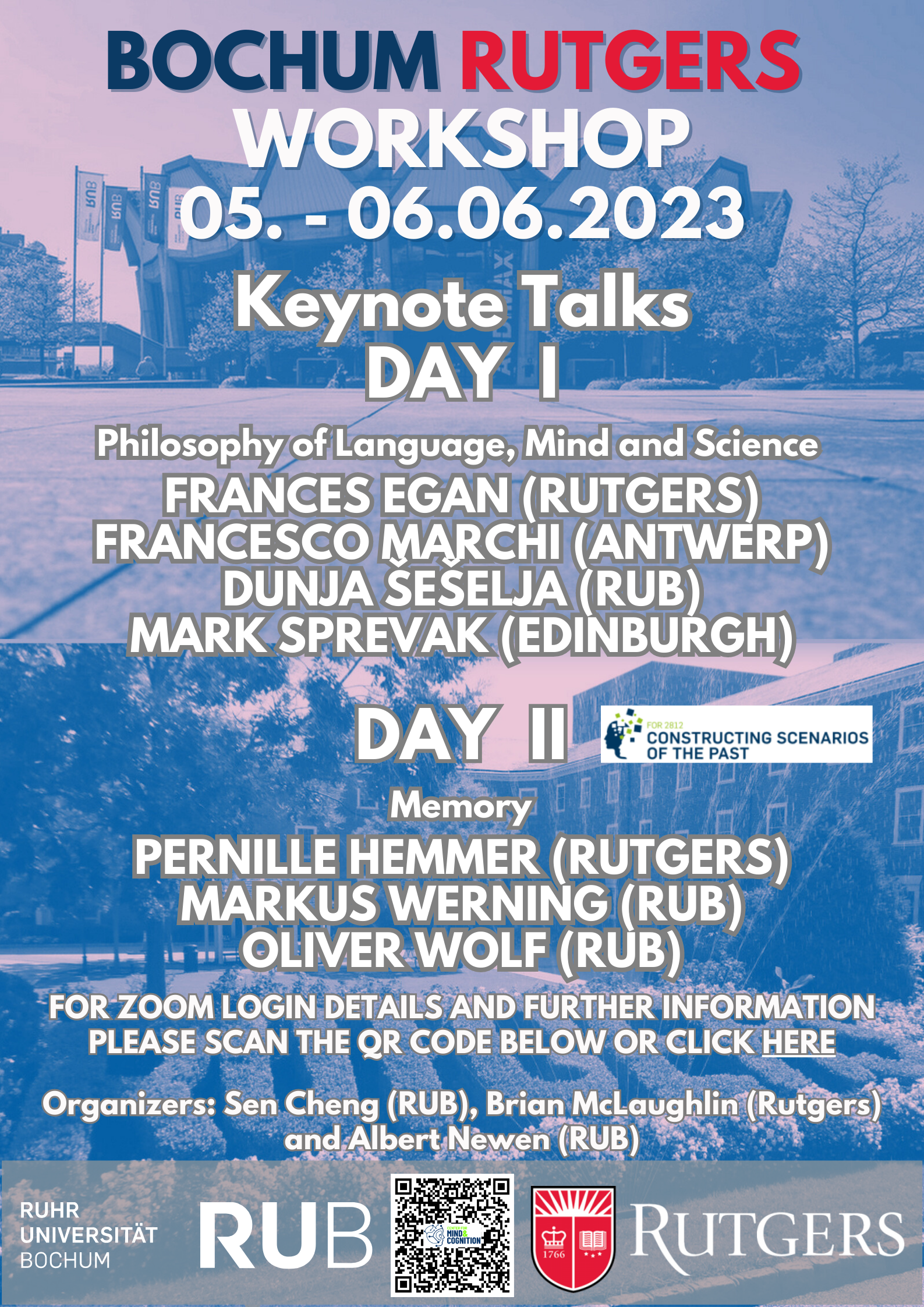
Monday, June 5th – Tuesday, June 6th, 2023
RUB, Sitzungszimmer HG
(Seminar room in the mensa building / level of the Café bar)
Keynotes online via Zoom
Organizers: Brian McLaughlin (Rutgers, New Brunswick, Dept. of Philosophy), Sen Cheng (RUB, Institute for Neuroinformatics), and Albert Newen (RUB, Institute of Philosophy II)
Monday, June 5th, 2023
DAY 1: Philosophy of Language, Mind and Science
Chair person: Robert Matthews, Rutgers
9:10 – 9:15 Welcome by Albert Newen
9.15 – 10.25 Keynote I – Mark Sprevak “In what sense do large language models understand what they say?”
10.25 – 11.10 AG McGee “Deterministic Doxastic Wrongings’”
11.10 – 11.40 Coffee Break
Chair person: Kristina Liefke, RUB
11.40 – 12.50 Keynote II: Dunja Šešelja “Towards epistemically responsible fact-checking of scientific claims
12.50 – 14.20 Lunch
Chair person: Brian McLaughlin, Rutgers
14.20 – 15.20 Keynote III: Francesco Marchi “The Rationality of Mental Imagery”
15.20 – 16.05 Julia Wolf: “Before Belief – Knowledge and Pretend Play”
16.05 – 16.30 Coffee Break
16.30 – 17.15 Alfredo Vernazzani & Andrew Rubner “In Defense of a Bundle View of Perceptual Content”
17.15 – 18.25 Keynote IV – Frances Egan ““Belief and its Linguistic Representation”
19.00 Dinner
Tuesday, June 6th, 2023
DAY 2: Memory: An interdisciplinary approach
Chair person: Sen Cheng, RUB
9.00 – 10.10 Keynote V – Markus Werning “Predicting the Past From Minimal Traces: Episodic Memory Without Storage”
10.10 – 10.55 Roy Dings “What does it mean to accurately remember? Towards an account of situated authenticity in episodic memory.”
10.55 – 11.20 Coffee Break
11.20 – 12.30 Keynote VI – Pernille Hemmer “The Memorability of Supernatural Concepts”
12.30 – 14.00 Lunch
Chair person: Pernille Hemmer, Rutgers
14.00 – 14.45 Sophie Siestrup “The influence of structure and content modification in episodic cueing on brain activity and memory”
14.45 – 15.30 Sandhiya Vijayabaskaran “How artificial agents learn and represent spatial behaviours”
15.30 – 15.50 Coffee Break
15.50 – 17.00 Keynote VII – Albert Newen “Memory, Self and selfless memories”
Remark: The keynote talks (but only those) will be available online. Please use the following Zoom link: https://us02web.zoom.us/j/86215674920?pwd=cFV1dWhXanNra2RNakkvWERXWmVtUT09
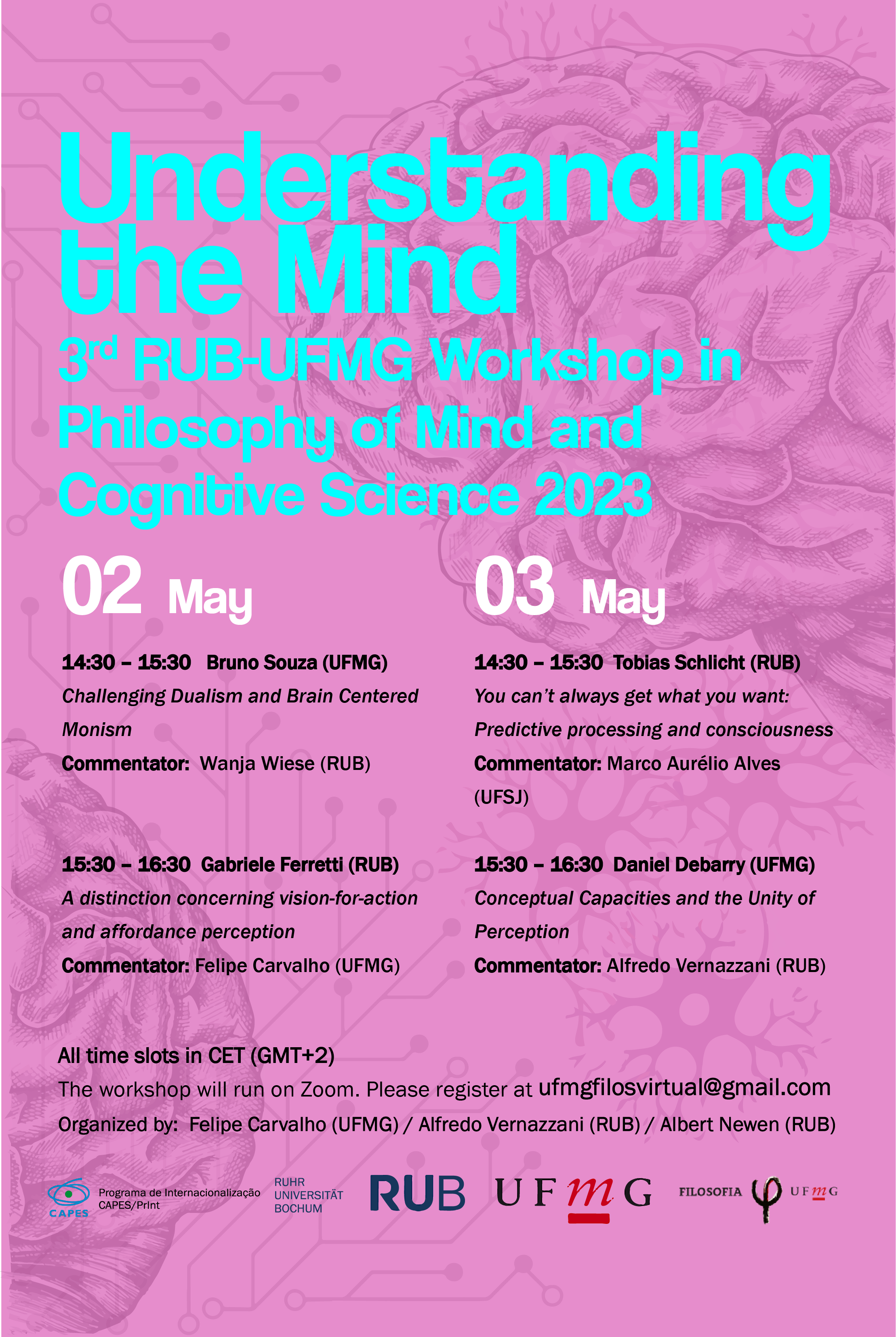
In the 3rd RUB-UFMG Workshop in Philosophy of Mind and of Cognitive Science, philosophers from the Ruhr-Universität Bochum and the Universidade Federal de Minas Gerais will discuss topics that include mind-body dualism, predictive processing and consciousness, the interface between perception and action, and conceptualism about perceptual content.
Each talk lasts for 30′ followed by a 10′ commentary and an open Q&A of 20′. The workshop is an online event. All talks will be streamed via Zoom.
14:30 – 15:30 Prof. Bruno Souza (UFMG) – Challenging Dualism and Brain-Centered Monism
Commentator: Wanja Wiese (RUB)
15:30 – 16:30 Gabriele Ferretti (RUB) – A Distinction Concerning Vision-for-Action and Affordance Perception
Commentator: Felipe Nogueira de Carvalho (UFMG)
14:30 – 15:30 Prof. Tobias Schlicht (RUB) – Predictive Processing and Consciousness
Commentator: Marco Aurélio Sousa Alves
15:30 – 16:30 Daniel Debarry (UFMG) – Conceptual Capacities and the Unity of Perception
Commentator: Alfredo Vernazzani (RUB)
All times are CET!
The workshop is an online event. All talks will be streamed via Zoom. Further information can be found on our website.
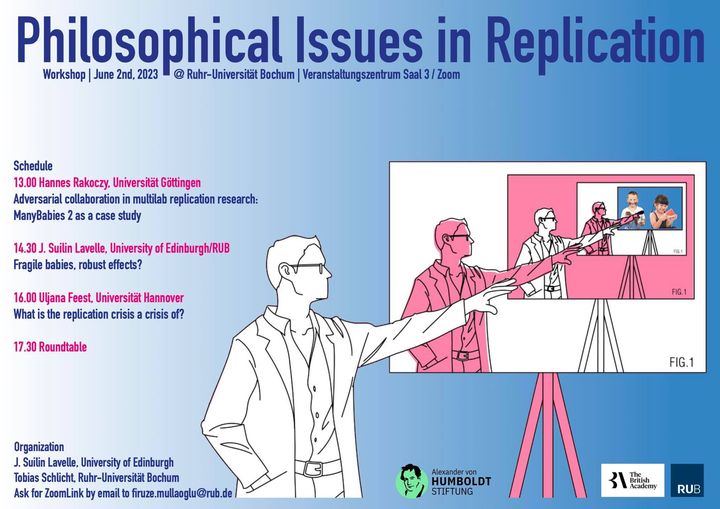
Workshop – Fr. the 2nd of June 2023 – Ruhr-Universität Bochum / Veranstaltungszentrum – Saal 3
Organized by: Suilin Lavelle (University of Edinburgh) & Tobias Schlicht (Ruhr-Universität Bochum)
Zoom-Link: Please send an email to Firuze.Mullaoglu@ruhr-uni-bochum.de
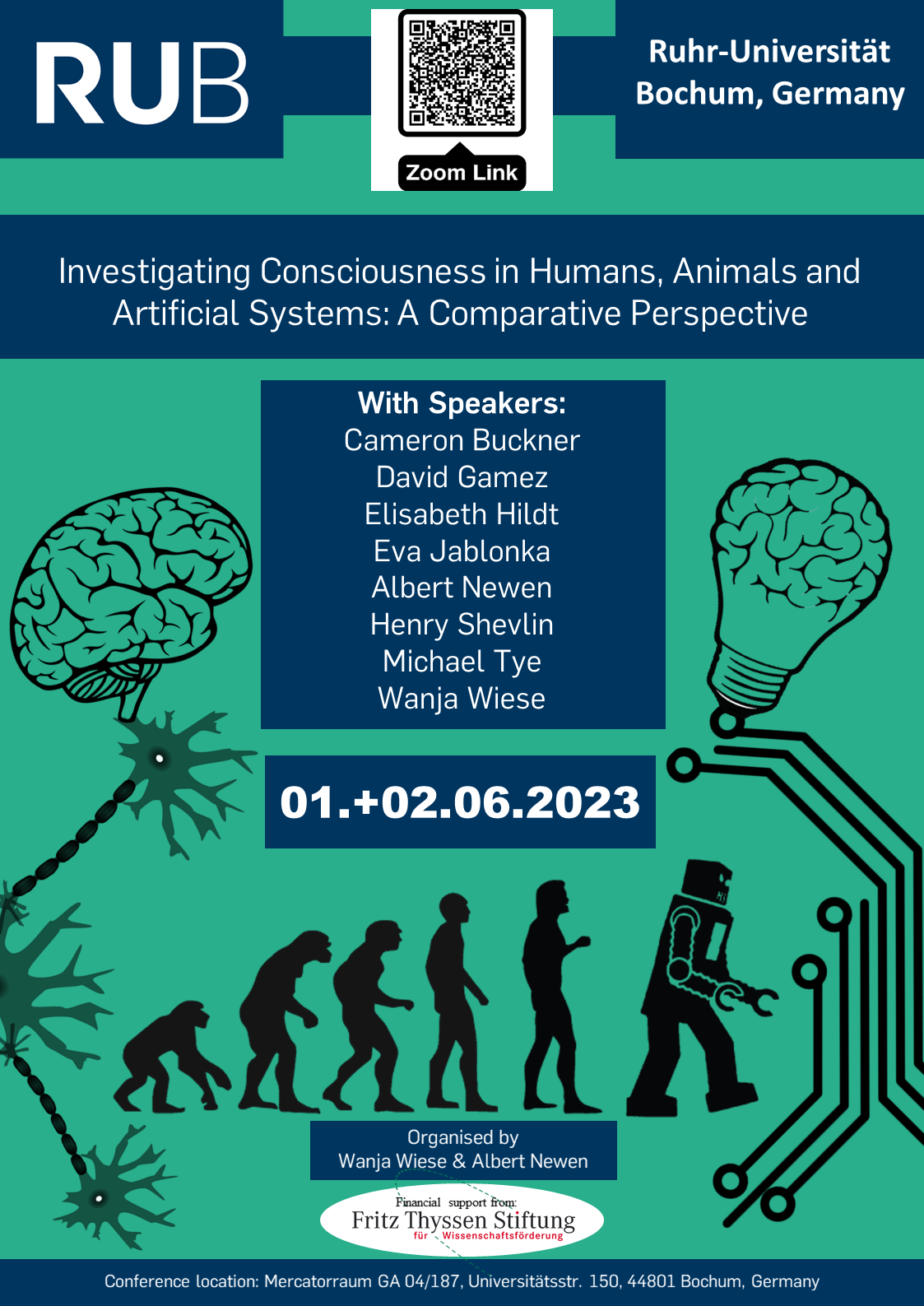
CFR: Workshop “Investigating consciousness in animals and artificial systems: A comparative perspective” (ICA 2023)
Organized by Albert Newen and Wanja Wiese
01.-02. June 2023, Bochum, Germany
For further and current information, click here
*******************
Tentative Schedule:
Organizers:
Albert Newen and Wanja Wiese (RUB, Institute of Philosophy II)
Venue:
Ruhr-Universität Bochum, Mercatorraum GA04/187 or online via Zoom (NEW: All talks will also be transmitted online)
Thursday, 1st of June 2023
09:30-10:40 Michael Tye: “Can a robot feel pain?”
10:40-11:25 Robert Matthews: “Knowing what it’s like to be an alien form of life”
11:25-11:45 Coffee
11:45-12:30 Albert Newen: „The interaction of theory-heavy and theory-light approaches to animal consciousness: The alarm theory of consciousness and cognitive profiles of animal consciousness”
12:30-14:00 Lunch
14:00-15:10 Eva Jablonka: “The evolution of animal consciousness: The learning route” (Note: The following talk is online only. However, present participants are not required to stream themselves.)
15:10-15:55 Leonard Dung: “Are tests of animal consciousness applicable to artificial systems?“
15:55-16:25 Coffee
16:25-17:10 Angelica Kaufmann: “Individual sentience profiles and why comparative neuroscience research needs them”
17:10-18:20 Cameron Buckner: “Artificial consciousness worth naturalizing: prospects for Large Language Models (e.g. ChatGPT4)”
19:00 Dinner
Friday, 2nd of June 2023
09:15-10:25 Henry Shevlin: “Mentalising beings: Human anthropomorphism and non-human consciousness”*
10:25-11:10 Wanja Wiese: “Understanding weak and strong artificial consciousness”
11:10-11:30 Coffee
11:30-12:40 David Gamez: “Seeing is deceiving: Why consciousness cannot be inferred from behaviour in animals and artificial systems”
12:40-14:15 Lunch
14:15-15.00 Katharina Dornenzweig: “Sentience in AI and biology: A comparative study of recurrent processing as a way forward”
14:00-15:45 Simon Brown: “Animal points of view in spatiotemporal structures of experience”
15:45-16:05 Coffee
16:05-17:15 Elisabeth Hildt: “Artificial consciousness: Conceptual analysis and ethical implications”
Registration:
Please send an email to hilfskraefte-newen@rub.de by May 20th, 2023.
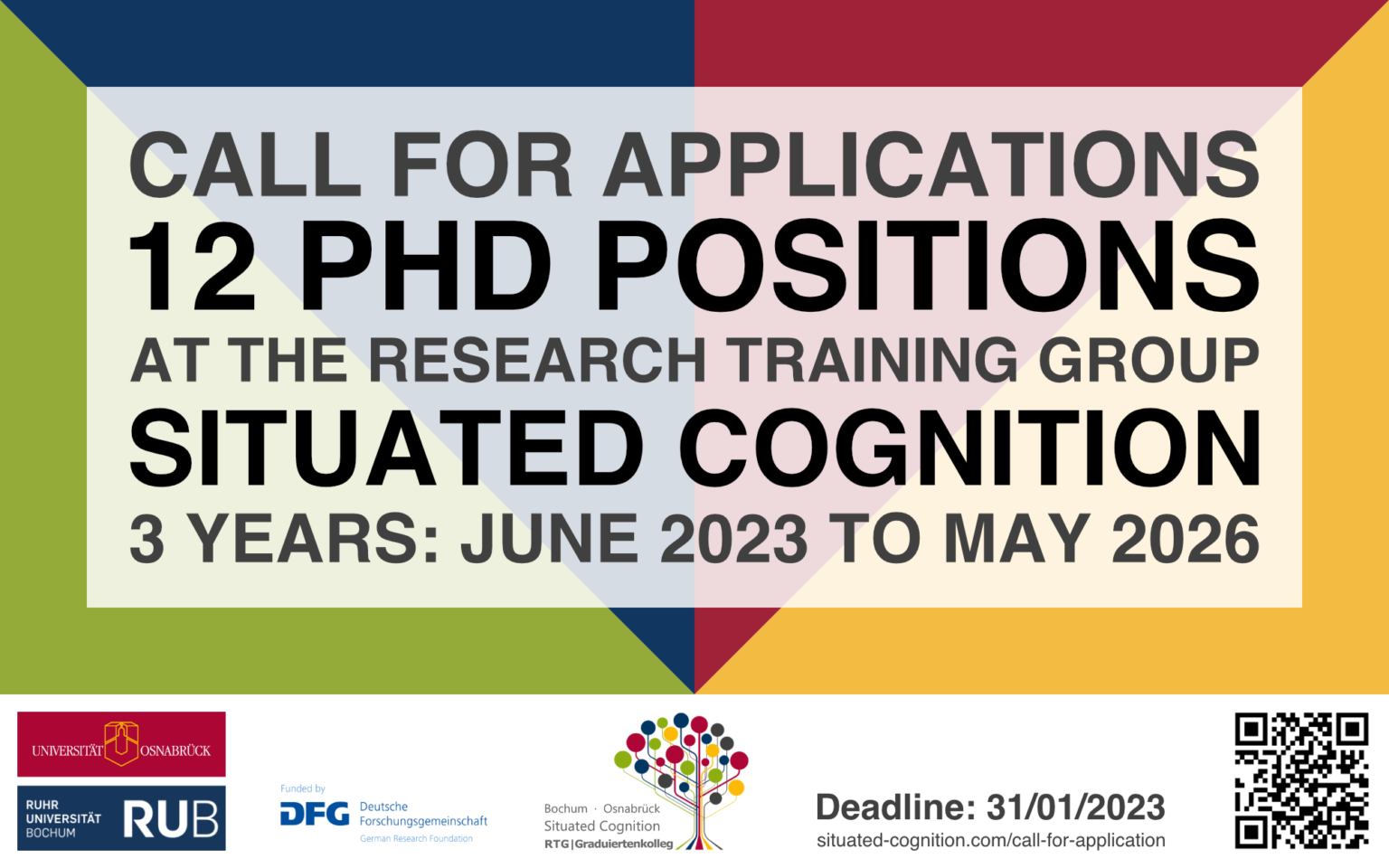
Call for Applications
The interdisciplinary Research Training Group Situated Cognition, funded by the Deutsche Forschungsgemeinschaft (DFG), invites applications for
12 Ph.D. positions (salary scale TV-L E 13, 65%)
for a three-year structured PhD program. The official, legally binding calls for applications from the Ruhr-University Bochum and the Osnabrück University are linked below.
The program and all positions will commence June 1st, 2023. The RTG is based at the Department of Philosophy II and the Faculty of Psychology at Ruhr-University Bochum as well as at the Institute of Cognitive Science and the Department of Philosophy at Osnabrück University.
Speakers:
- Prof. Dr. Albert Newen (Ruhr-Universität Bochum)
- Prof. Dr. Achim Stephan (Universität Osnabrück)
- Prof. Dr. Nikola Kompa (Universität Osnabrück)
All PhD positions are essentially interdisciplinary with an emphasis on one of the subjects involved, i.e. philosophical theory formation, experimental psychology or neuroscience. Applicants have to apply for one of the suggested projects (max. two with indication of preference). In addition, we invite applicants to submit their own original project proposal in one of the theoretical areas, as long as the proposal fits the RTG’s guiding idea. Information about the guiding ideas of the RTG and the PhD projects can be found at www.situated-cognition.com
Preconditions
Theoretical projects:
Candidates who apply for or suggest a theoretical project are expected to have an excellent M.A., M.Sc. (or Staatsexamen degree) in Philosophy or Cognitive Science. They should have expertise in at least one of the following areas: Philosophy of Mind, Philosophy of Self-Consciousness or Social Understanding, Philosophy of Language, Philosophy of Action, Philosophie of Artificial Intelligence or Perception. Furthermore, we expect advanced knowledge in at least one of the following areas: Cognitive Psychology, Behavioural Biology or Neuroscience.
Empirical projects:
Those applying for an empirical project are expected to have an excellent M.Sc. (or equivalent) in Cognitive Science, Psychology, Neuroscience or in an equivalent field. The candidate has to prove that she/he is able to work out one of the empirical projects described on our website.
Application Procedure
Applications should contain the following documents:
- The application form (please download from below and fill out)
- A letter of motivation including the applicant’s research interests and motivation to work within the RTG. This should include a selection of one (or two) PhD-projects (see https://situated-cognition.com/projects/latest-projects/)
- Curriculum vitae
- Copies of degree certificates
- A writing sample (in German or English): the core chapter of the Diploma/Master’s thesis or preferably one relevant publication (if available)
- Optional: an outline of an original theoretical project which fits into the RTG’s framework (see the RTG-website and the websites of the PIs)
Please send all the required documents in two PDF files:
- One PDF file containing all the application documents, starting with the application form
- One PDF file with your writing sample
We stand for diversity and equal opportunities. For this reason, we favour a working environment composed of heterogeneous teams, and seek to promote the careers of individuals who are underrepresented in our respective professional areas. We expressly request job applications from women. In areas in which they are underrepresented they will be given preference in the case of equivalent qualifications with male candidates. Applications from individuals with disabilities are most welcome.
Applications and and inquiries should be addressed to:
Prof. Dr. Albert Newen, Speaker of the RTG
Ruhr University of Bochum
E-Mail: RTG-SituatedCognition{at)rub.de
APPLICATION DEADLINE: February 5th 2023. All interviews will be held in English.
Important Links
Download PDFs
Download Application Form PDF
Download Application FAQ PDF
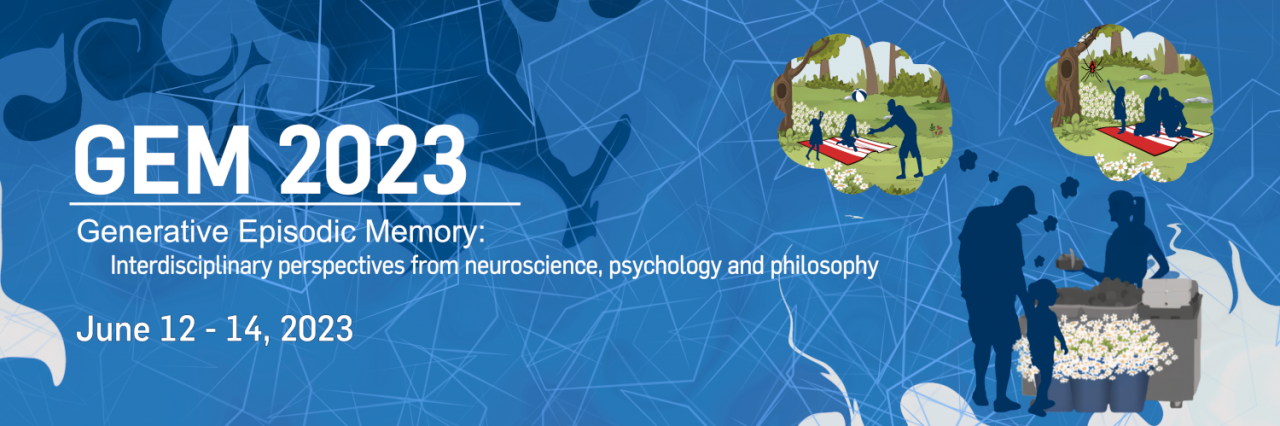
Generative Episodic Memory: Interdisciplinary perspectives from neuroscience, psychology and philosophy
Call for abstracts
We invite submissions for symposia, talks and posters. Please note that all presentations are in person.
Submission guidelines:
Abstracts must be submitted in English and be no longer than 500 words. Submitted work must be original and unpublished and submitted electronically at https://www.conftool.net/gem2023/
Types of submissions:
- Talks
- Symposia: In addition to submitting individual talks there is also the option to submit a set of talks (henceforth called symposium). Symposia must be interdisciplinary in nature, i.e., they must contain talks from at least two of the following disciplines: computational neuroscience, philosophy, psychology, neuroscience, and must comprises 3 talks. Please note that if one or more of the talks that make up the symposium are rejected the remaining talks are not automatically rejected. They will be scheduled into the general program by the program committee.
- Posters
Please ensure that your files are in PDF format and are no larger than 10 MB.
Abstract submission deadlines [GMT +1 (CET)]:
Abstract submission – 15.03.2023
Notification of acceptance – 15.04.2023
For more information, click here