A German-Canadian research team is calling for a more comprehensive approach.
Dr. Sabrina Coninx from Ruhr-Universität Bochum and Dr. Peter Stilwell from McGill University, Canada, have investigated how philosophical approaches can be used to think in new ways about pain and its management. The researchers advocate not merely reducing chronic pain management to searching and treating underlying physical changes but instead adopting an approach that focuses on the person as a whole. Their work was published online in the journal “Synthese” on 15 April 2021.
It is not currently possible to treat chronic pain effectively in many cases. This has encouraged researchers from various disciplines to consider new approaches to pain and its management over recent years. “Pain research and clinical practice do not take place in a vacuum, but instead involve implicit assumptions regarding what pain is and how it can be treated,” says Sabrina Coninx, research assistant at the Bochum research training group Situated Cognition. “Our aim is to shed light on these assumptions and discover how we can think in new ways about pain and its management with the help of philosophical approaches.” In their work, the authors develop a holistic, integrative and action-oriented approach.
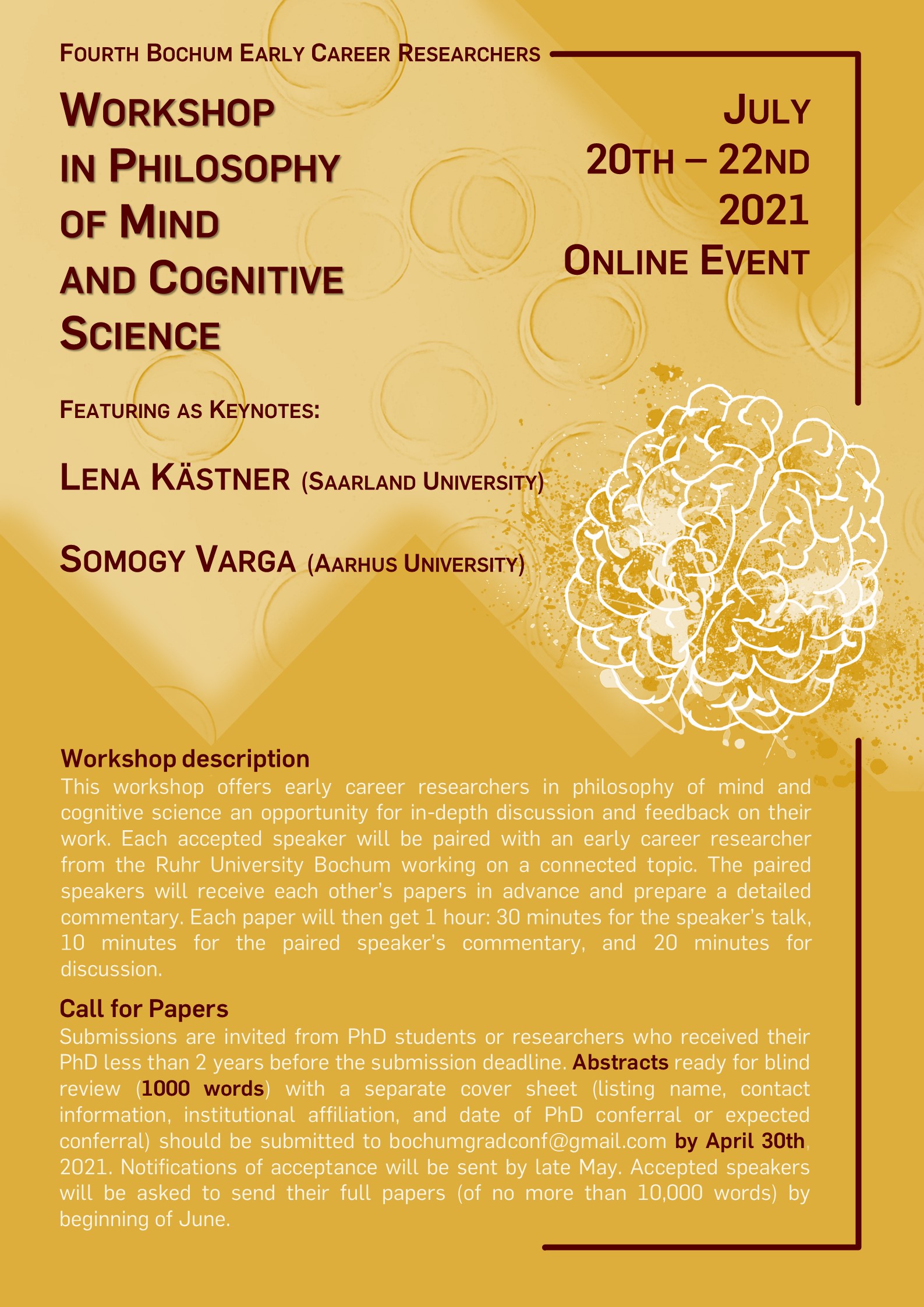
Fourth Bochum Early Career Researcher Workshop has a call for papers open! The workshop is an annual event by and for graduate students and early career researchers. It is a platform where people entering the academic job market have the opportunity not only for in-depth feedback on their work, but also for personal engagement and career advice from respected senior academics. Submissions are invited from PhD students or researchers who received their PhD less than 2 years before the submission deadline. Consider applying if you would like to boost your academic perspectives!
Bochum hat sich erfolgreich im bundesweiten Wettbewerb für das neue nationale Zentrum für die Spitzenforschung zur Verbesserung der psychischen Gesundheit durchgesetzt.
Psychische Störungen betreffen in Deutschland mehr als ein Drittel aller Menschen im Laufe ihres Lebens. Um sie verstehen, vermeiden oder erfolgreich behandeln zu können, muss der Blick auf Lebensspannen und Lebenswelten gerichtet werden. Mit dieser Überzeugung ist „LIFE TBT“ angetreten: Der Verbund, der von Prof. Dr. Silvia Schneider vom Forschungs- und Behandlungszentrum für psychische Gesundheit der RUB koordiniert wird, ist ein Standort des Deutschen Zentrums für Psychische Gesundheit. Das Zentrum aus insgesamt sechs Standorten ist auf Dauer angelegt und soll mit 30 Millionen Euro jährlich von Bund und Ländern gefördert werden. „Der Bochumer Erfolg ist nicht nur für die Ruhr-Universität mit ihrer langen Tradition in der Psychologie ein enormer Erfolg und ein Ausweis der Exzellenz, sondern auch ein weiterer Meilenstein für die Wissensmetropole Ruhrgebiet“, so Prof. Dr. Axel Schölmerich, Rektor der RUB. Den vollständigen Artikel finden Sie unter: https://news.rub.de/wissenschaft/2021-03-10-psychologie-rub-ist-standort-des-deutschen-zentrums-fuer-psychische-gesundheit
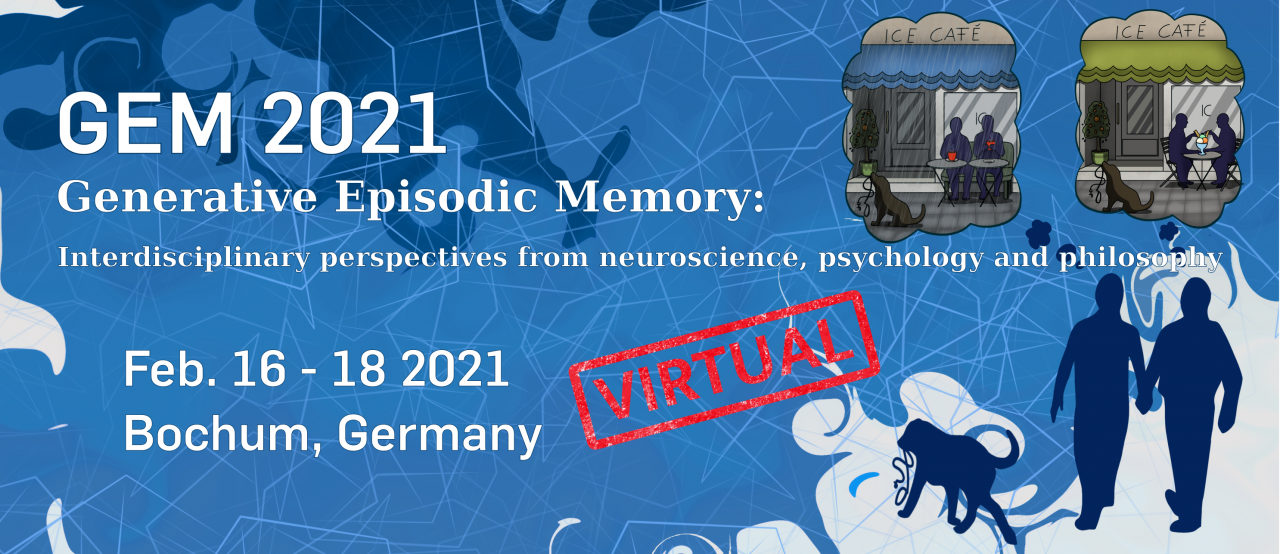
16.02.2021 – 18.02.2021 (online, via conference platform “Whova”)
Organized by: Research unit FOR 2812 “Constructing scenarios of the past: A new framework in episodic memory”
Abstract
Episodic memories are widely regarded as memories of personally experienced events. Early concepts about episodic memory were based on the storage model, according to which experiential content is preserved in memory and later retrieved. However, overwhelming empirical evidence suggests that the content of episodic memory is – at least to a certain degree – constructed in the act of remembering. Even though very few contemporary researchers would oppose this view of episodic memory as a generative process, it has not become the standard paradigm of empirical memory research. This is particularly true for studies of the neural correlates of episodic memory. Further hindering progress are large conceptual differences regarding episodic memory across different fields, such as neuroscience, philosophy, and psychology. This interdisciplinary workshop therefore aims to bring together researchers from all relevant fields to advance the state of the art in the research on generative episodic memory.