
Nikola Andonovski (Johns Hopkins University)
Memory as triage: Facing up to the hard question of memory.
10.12.2020, 16:15-17:45 CET (UTC+01:00).
Online Lecture via zoom.
Login information:
Zoom:
https://us02web.zoom.us/j/82970505769?pwd=NGpHL3VHUUg0bktTbnBIT2kxMWVYZz09
- Meeting ID: 829 7050 5769
- Password: 8rraW0
Abstract: The Hard Question of memory is the following: how are memory representations stored and organized so as to be made available for retrieval in the appropriate circumstances and format? In this essay, I argue that philosophical theories of memory should engage with the Hard Question directly and seriously. I propose that declarative memory is a faculty performing a kind of cognitive triage: management of information for a variety of uses under significant computational constraints. In such triage, memory representations are preferentially selected and stabilized, but also systematically modified and integrated into generalized, model-like representational structures. The account, I argue, points to a new kind of preservationist theory, on which the preservation of information in memory goes hand-in-hand with the maintenance of its relevance.

Marta Caravà (Università di Bologna)
Untangling forgetting: An enactive proposal.
03.12.2020, 10:00-11:30 CET (UTC+01:00).
Online Lecture via zoom.
Login information:
Zoom:
https://us02web.zoom.us/j/82970505769?pwd=NGpHL3VHUUg0bktTbnBIT2kxMWVYZz09
- Meeting ID: 829 7050 5769
- Password: 8rraW0
Abstract: Remembering and forgetting are the two poles of human memory. Consequently, any approach to memory should be able to explain both. Can an enactive approach to memory processes do so? In the talk, I will outline a possible way to give a positive answer to this question. In line with some current enactive approaches to memory, I will suggest that forgetting –similarly to remembering– might be underpinned by an embodied and active process. Within this process, some simulation and re-enactment paths would acquire more relevance than others. This acquired relevance would make the activation of other paths of recall less likely, thus preventing the memory system from engaging in some past-oriented episodic simulations. These changes in the likelihood of activation of some paths of recall –the forgotten ones– can be explained in an enactive fashion by studying both “internal” and “external” re-enactment and simulation paths. With regard to the latter, I will propose to investigate forgetting by considering the engagement and affective relation of an embodied agent with her field of affordances. I will suggest that, in particular in the case of emotion-laden memories, the agent’s decoupling from some affordances of the environment might contribute to the process of forgetting, in that it would constrain the agent’s opportunities for situated past-oriented episodic simulations.

A new research group headed by Prof. Sen Cheng from the Institute of Neuroinformatics and founded by the German Research Foundation will start in July 2019 at the Ruhr-University Bochum. The research group aims to develop a theory of episodic memory based on scenarios, i.e. mental simulations of past events.
(more…)

Wie Dohlen sich merken, was sie wann wo getan haben (How jackdaws remember what they did where and when)
Doktorandin Aylin Klarer verbringt viel Zeit mit den Dohlen – das muss sie auch, denn die Wildvögel sind Neuem gegenüber sehr skeptisch.
Um mit den exzentrischen Krähenvögeln zu arbeiten, braucht es Geduld und Zeit. Aber sie gehören zu den intelligentesten Vertretern im Vogelreich.
For full article, see RUB News
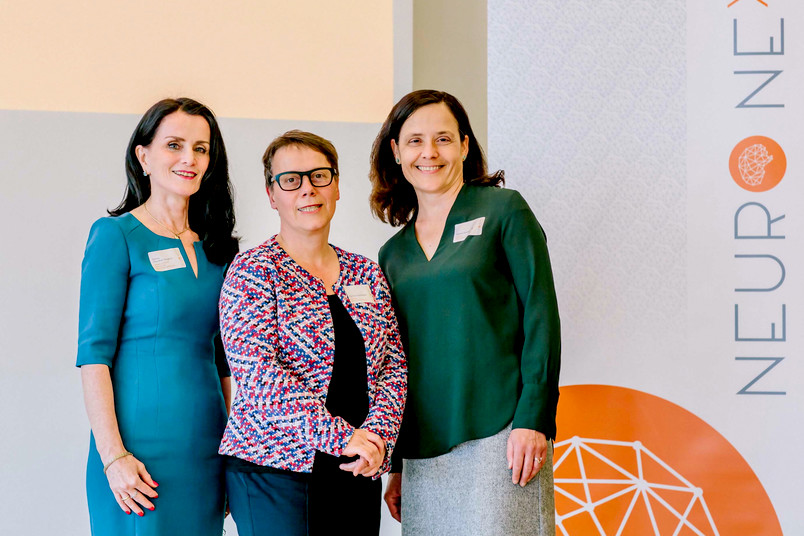
Karriereplattform für Neurowissenschaftlerinnen gestartet
(New career platform for female neuroscientists)
Denise Manahan-Vaughan, Gründerin von Neuronexxt, zusammen mit RUB-Kanzlerin Christina Reinhardt und SFB-Koordinatorin Sabine Dannenberg bei der Auftaktveranstaltung
Das in Bochum gegründete Netzwerk will Forscherinnen international sichtbarer machen. Zugleich ist es ein nützliches Tool für die Recherche.
For full article, see RUB News